The note above is a one pound note (£) from the national bank of Scotland. The national bank was founded in 1825 in Edinburgh, Scotland and was a commercial bank until 1918 when Lloyds bank took them over. They continued to use the name until 1959. After a few takeovers it eventually became part of the Royal bank of Scotland, which still operates today.
This is the second £1 note from this bank but this is in a much better condition and was issued in 1958, one year earlier than my previous one. A wee thank you to my friend Gillian who gave me this beautiful note. You can see more notes from Scotland HERE
This note above is the 10 Livre note issued in 1986 by the Lebanon. the front has athe ruins of Anjar and the reverse has these gigantic rocks from just outside Beruit .
This note is from across the border from the previous post. This is the 2 Sudanese pound note from 2017 . It has pottery on the front and musical instruments on the reverse.
Here we have two additions to my collection of notes of the world newest country (i think) . I already have the 1, 5 and 50 pound notes
The first is the 10 pound note from South Sudan with, as all the notes have, John Garang, who led the "Sudan Peoples Liberation Army" on the front and in the case of the 10 pound, buffaloes and a pineapple on the reverse. this note is from 2016
The second note is the 20 pound note from 2017 with a similar front but with Oryx and a oil derrek on the reverse.
This is the 50 Pound note from the world's newest country, South Sudan. as with all this set of notes it has John Garang on the front but with elephants on the reverse
These notes above were a Christmas present and are quite exciting. They are 5 and 10 pound notes from 2016 and both have the same serial number which makes them collectable how ever there is also a print error in the 10 pound note
on the front of the £5 note is the bank's old headquarters in Edinburgh and Sir Walter Scott whereas the reverse has a picture from "brig o' doon" . "Brig" is scots for bridge and this bridge from Ayrshire in Scotland, is the setting for the burn's poem "Tam o' Shanter"
The £10 note has a similar front view to the £5 note but the reverse has the Glenfinnan Viaduct. The viaduct has been featured in many films including some of the Harry Potter films.
This colourful note is the 100 pounds from Syria and was issued in 1998 with the Bosra roman theatre in south west Syria on the front and the Hajaz railway loco and Damascus train station on the reverse.
After the human misery caused by the war in Syria , the loss of the culture of Syria is a huge loss that cannot be repaired.
Northern Ireland has had them for ages, All 3 Scottish Banks now have them and finally the bank of England has released a Polymer note - the last UK bank to do so. It was issued in September of this year (2016) and has caused a bit of a stir as Sir Winston Churchill has replaced the last woman on bank of England Notes (Elizabeth Fry)
The front has Queen Elizabeth II and Winston Churchill on the reverse.
These notes are two versions of the British 1 pound note issued by different banks. The lower one was issued by the Bank of England up until 1988 when the £1 coin took over and £1 notes were discontinued, likewise with the Bank of Scotland note which was issued until 1988, although the Royal bank of Scotland still issues £1 notes.
The first note is the £1 note issued in 1981 by the Bank of Scotland, with Sir Walter Scott on the front and a sailing ship and the medallion of Pallas on the reverse.
The bank of England £1 note issued between 1981 and 1984 with Queen Elizabeth II on the front and Sir Isaac Newton on the reverse.
here we have a bilingual note from Jersey, a british crown dependency and an island in the English channel It is a one pound (£1) note from 2010. the front has a quite old looking, Queen Elizabeth and liberation square in St Heliers while the reverse has Le Hocq tower and La Hougue Bie
If the previous note was large then this one is tiny 6cm x 4cm ( 2 3/8 in x 1 5/8 in ). here we have a 3 piastre note with George VI on the front . Cyprus became a crown colony of Britain in 1925 and they fought along side the British in WWII. The Greek Cypriots wanted independence from Britain at the end of the war whereas the Turkish Cypriot wanted British rule to continue.The Bitish Occupation would continue until 1960.
My friend has a holiday home in Kyrenia (Girne in Turkish ) and my friend Hammam goes to the American university there, It looks an amazing place but very hot !!.
Here we have a one pound note from the states of Jersey, which is one of the channel isles and a British crown dependency but not part of the united kingdom . It is officially called the Bailiwick of Jersey
The front has a picture of Queen Elizabeth II and on the reverse it has a depiction of the painting by John Singleton Copley Called "the Death of Major Peirson " at the Battle of Jersey in January 1781
This is the 1000 Livres from Lebanon. I cant see a date on it (but my Arabic is very rusty) but I think it is from an issue after 2006, possibly 2011 or 2012. I spent a bit of time trying to work out the Arabic numbers in the serial number, which is on the top left and then realised that there was a copy of it on he lower right in roman numerals. You can find out about the features of Lebanese notes at the website of the Banque Du Liban .
Although it is named in Lebanese Livres it is called still called the Lebanese pound.
Still the world's newest country inaugurated in 2011. this is the 5 pound note from 2011 with John Garang on the front and African cattle on the reverse.
This is the one pound (£1) from Cyprus issued in 1993. the bank name is in Turkish and Greek on the front and English on the back. The front has a mosaic of a nymph and on the reverse is the abbey at Bellapais .
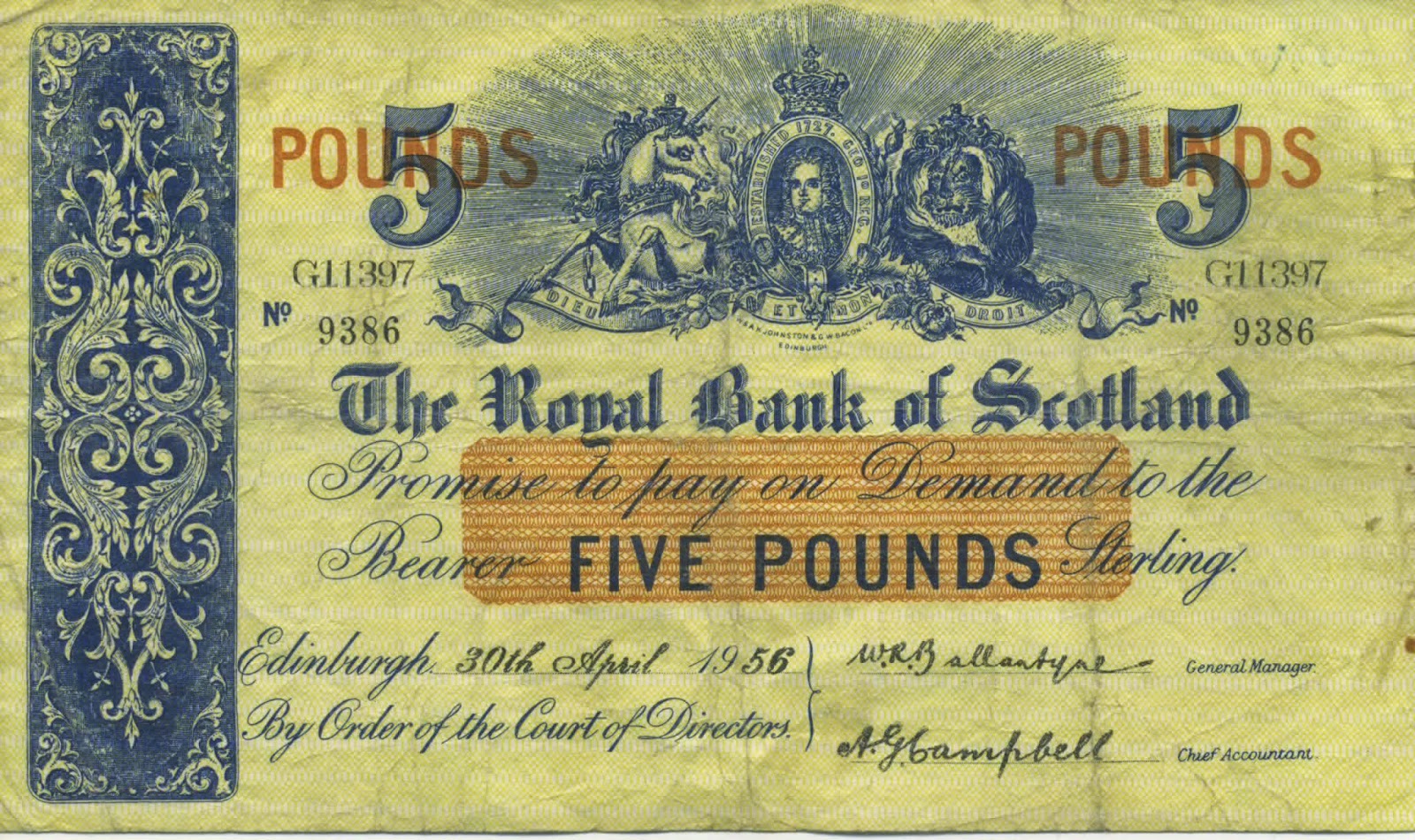
This one is one i got excited about - I know getting excited about an old out-of-date fiver is sad !! I haven't added any new Scottish notes for ages. This is a 5 Pound (£5) from the Royal Bank of Scotland and dated 1956 and is uniface i.e. the back is blank.
Rather than the signatures, which usually define the date of the note (other than when it is printed on it ) in this case it is the printer that is significant. This note it has W and AK Johnstone and G W Bacon ( you can see it just below the crest in the top middle of the note) if it has just AK Johnstone LTD it is more desirable and therefore more expensive and if it has the first one with LTD added to G W Bacon its the most desirable of all, demanding a premium amount !!
The last 5 post all contained notes from the same seller - world paper money - on ebay and as a nice gesture they included the notes above as a bonus gift, which was really nice. although I already have a 10p british armed forces note, i didn't have the bank of England one pound note. This one pound note was issue between 1949 and 1955 but doesn't use a date on it this one has the P S Beale signature on it that dates it .
Historic Huddersfield banknotes have a new home ... in the USA.
They were bought by a descendant of John Dobson who founded Huddersfield Old Bank and so are back with the family.
In July we ran a story about John Dobson and Sons bank notes being auctioned for thousands of pounds.
Now we can reveal that three of them were bought by Sandi Hewlett who lives in Pennsylvania.
She said: “I managed to bid high enough to obtain three of the four notes at auction.
“My interest in these notes is because John Dobson (1753-1818) who founded the bank and his son John Dobson (1780-1857) were my fifth and fourth great grandfathers, respectively.
“One of the notes is valued at one pound and is signed by J Dobson on August 1, 1823.
“Through my genealogy research I have found other descendants of John Dobson (1753-1818) and his wife Sarah Wood and of his son John Dobson (1780-1857) and his wife Anna Maria Walker. We’re all quite pleased to have a bit of memorabilia from our ancestors.”
Sandi was born in New York City, is married to Larry and has lived in Pennsylvania for 32 years.
She works as a full-time genealogist, mostly researching for clients with Pennsylvania ancestry.
She was certified by the Board for Certification of Genealogists (Washington, DC) in 2001. Sandi now serves on the Board of Directors for the International Society of British Genealogy and Family History.
Not surprisingly with such experience at genealogy Sandi has an in depth knowledge of her own family history.
Her ancestor John Dobson (1753-1818) founded the Dobson & Sons bank, which was inherited by his two sons, John Dobson (1780-1857), and his brother William Beevers Dobson (1788-1839). William Beevers Dobson did not marry.
Sandi said: “When Dobson & Sons Bank filed for bankruptcy in 1826 John Dobson and his wife Anna Maria (Walker) Dobson (daughter of Joshua Walker and Martha Sykes) moved with their unmarried children from their home in Almondbury to London where they resided in Southwark.
“John Dobson became a hop merchant and employed two of his sons.”
The only child of John Dobson and Anna Maria to remain in Yorkshire was Emma Maria Dobson (1804-1851) who married William Jacomb (1795-1868) at Almondbury in 1826. He was a Huddersfield lawyer who was born in London. Both are buried at St Peter’s Church, Huddersfield.
Sandi adds: “One of John Dobson and Anna Maria’s daughters, Eliza Louisa Dobson, married George Stacey, on February 6, 1828 at St Saviour in Southwark.
“In 1836 George Stacey and Eliza Louisa – along with three of their four children – sailed to Canada where they settled in what is called the Eastern Townships of Quebec which was quite a wilderness at that time. Their daughter, Louisa, who remained in England, eventually sailed for Canada to join her family in 1849. Up to that time, Louisa lived with her grandparents George Stacey and Sarah (Hubbard) Stacey at the Tower of London where her grandfather, George Stacey, worked in the Ordnance Department for 60 years from 1807 until he retired in 1858.
“George Stacey and Eliza Louisa are my third great grandparents. Their son Alfred Stacey (1836-1907) had a daughter Bertha Caroline Stacey who married Henry Herbert Winslow in 1881 in Sherbrooke, Quebec, and they are my great-grandparents.
Henry (1852-1925) and Bertha (1862-1922) had a daughter Mae Winslow who is my grandmother.
Mae Winslow (1894-1975) married Reginald Lobdell (1891-1951) at Eaton Corner, Quebec, in January 1913 and then they moved to New Hampshire in 1914.
Their daughter Evangeline Lobdell is my mother, born February 1920 in Bartlett, New Hampshire.”
Most of Sandi’s research was conducted in England, both in London and at the Huddersfield Library and the Yorkshire Archives in Wakefield.
East Yorkshire artist Leonard Brown has made a sculpture of The Beatles’ Eleanor Rigby out of £1m of old bank notes and is exhibiting her at Beverley Art Gallery - after taking inspiration from a woman he saw in Hull city centre. Faye Preston reports.
SHE is Britain’s most famous spinster, but thanks to a Hull artist she need never be lonely again. For Leonard Brown’s sculpture of Eleanor Rigby – made out of £1m of old banknotes – is attracting scores of Beatles-lovers and art-lovers from across the area.
Displayed at Beverley Art Gallery, Eleanor Rigby The Million Pound Bag Lady, is a bold statement about poverty and wealth and she is inspired not only by the genius songwriting of Sir Paul McCartney, but by a chance sighting of an elderly lady he saw hobbling hunchbacked through Hull’s city centre almost a year ago.
Leonard, 70, said: “I saw an old lady carrying all these bags in the city centre and I thought it would make a wonderful picture. It was so sad to see and it touched me. I thought about where she was going and what she was thinking.
“I went back and drew her and as I did I got thinking about the most famous bag lady there is – Eleanor Rigby. Every town has one, you see them everywhere you go. Old ladies with more bags than they can carry, dawdling along. I hope this speaks to everyone.”
Standing about 4ft tall, her cast is made from wire and wood and her chest cavity is stuffed with £300,000 of old bank notes alone. The rest of the dosh carefully tones her face with peach-coloured “tenners” as well as the darker creases of her coat and bags.
Alongside the sculpture read the words: “I cried because I had no shoes until I saw a man who had no feet.” It is a saying he was brought up with as a child in inner-city Liverpool and one he feels is more relevant today than ever before.
He said: “Everywhere you go people are crying about what they don’t have. This sculpture is a statement about wealth and poverty and the fact people want so much when they have so much already.”
It took Leonard months to convince the Bank of England to hand over the money. Not one to be fobbed off, he went straight to the top and called the Governor first. After being passed down the chain and proving his need for the cash was genuine, he finally bagged an appointment to pick up the notes.
“I can imagine the girl’s face when she hears this Scouser on the end of the phone asking for £1m,” said Leonard. Sitting in the grand foyer of the Bank of England, a security guard rolled out a trolly load of black bin liners stuffed with the notes – to the jaw-dropped expressions of onlookers.
“No one knew the money was shredded,” said Leonard. “Everyone was staring at me and I just pushed it out of the door and started loading up the boot of my car. I didn’t know how much a million pounds of shredded notes would be. It still makes me laugh thinking about it.”
Leonard has since sent photographs of Eleanor to the Bank of England, who replied telling him it was “absolutely fantastic”.
He is also waiting with crossed fingers for a response from Sir McCartney himself and dreams of her being displayed at the Tate Liverpool. But until then, Eleanor Rigby will take centre stage at Beverley’s gallery – and is already drawing in a crowd.
Nial Adams, museum manager, feels Eleanor is at home among the display of Fredrick Elwell’s works because both provide a type of social commentary.
He said: “This is a searing critique of modern Britain. It is a striking, interesting sculpture with a very serious idea behind it. Although the material is old, used bank notes, it is tactile and has warmth. It makes you want to give her a cuddle.”
Eleanor Rigby The Million Pound Bag Lady will be displayed until Thursday, October 17.
Paul McCartney's churchyard inspiration for Eleanor Rigby
RELEASED on August 5, 1966, Paul McCartney’s heartbreaking lyrics, “Eleanor Rigby died in the church and was buried along with her name; nobody came” strikes a chord that many may recognise as fear. To this day, scores of Beatles fans visit St Peter’s Church’s neat yard in the Liverpool district of Woolton where the real Eleanor Rigby lies.
She is now widely thought of to be the subconscious inspiration behind the song that spent four weeks at number one in the UK chart in 1966. Strangely, it was here John Lennon and Paul McCartney met for the first time.
It is a short distance from Lennon’s childhood home on Menlove Avenue and he would frequently play in the graveyard after singing in the choir. But though many people believe this is the song’s heroine’s final resting place, details about her life still remain scarce.
THE Bank of England is not known for presenting its research in shopping centres. Usually, its number-crunchers swap ideas with their wonkish counterparts in dingy rooms in Washington, DC or Frankfurt. But its latest project is different: for three years the Bank of England has been studying its banknotes. Now it wants to persuade the public that they should be made out of plastic.
Of Britain’s cash, broadly defined, only about 3% has any physical form (the rest is digital). Three billion notes are in circulation, with a face value of about £58 billion ($92 billion). On September 10th Chris Salmon, the bank’s chief cashier, said it wants to stop making certain notes from paper (actually derived from cotton and linen) and, from 2016, use polymer for the £5 and £10 notes.
In 2012, the Bank withdrew from circulation some 720,000 fake notes, with a face value of £13m. Australia, which uses polymer notes, has lower counterfeit rates than Britain.Over 20 countries already use such notes. They cost more to make but are better value (saving £100m, the Bank reckons). Paper money gets dirty and damaged quickly. The much-used £5 note typically lasts only nine months. Polymer notes can last six times as long. They can even go in the washing machine. They are also harder to forge. Mr Salmon proudly showed off a transparent window on a prototype tenner, which makes such notes hard to counterfeit. Merchants can more easily spot the absence of security features on clean notes.
Banks will need to change their cash machines. But the big worry is the public’s reaction to the smooth, springy feel of the new notes. Hence the shopping centres: the Old Lady will make over 30 presentations in such locations. Just don’t expect any giveaways.