SUB

A TOTALLY AMATEUR BANKNOTE COLLECTOR
Showing posts with label euro. Show all posts

Thursday, 7 May 2015

ANDORRA NOTE


Another test note here, this time from Andorra.officially the Principality of Andorra , is a sovereign landlocked microstate in Southwestern Europe, located in the eastern Pyrenees mountains and bordered by Spain and France. It is the sixth-smallest nation in Europe, having an area of 468 km2 (181 sq mi) and a population of ca. 85,000. Its capital Andorra la Vella is the highest capital city in Europe, at an elevation of 1,023 metres (3,356 ft) above sea level. The official language is Catalan, although Spanish, Portuguese, and French are also commonly spoken.

 It is not a member of the European Union, but the euro is the de facto currency. It has been a member of the United Nations since 1993.

the note above is the 5 pessetes note with the marineda bridge on the reverse


Sunday, 29 March 2015

MONACO


Monaco, officially the Principality of Monaco, is a sovereign city-state and microstate, located on the French Riviera in Western Europe. It is bordered by France on three sides; one side borders the Mediterranean Sea. Monaco is the second smallest and the most densely populated country in the world.. Monaco's most populous Quarter is Monte Carlo and the most populous Ward is Larvotto/Bas Moulins. Through land reclamation, Monaco's land mass has expanded by twenty percent.

MONETARY UNITS

1 ( Monegasque) franc = 100 centimes (until 2002)

1 euro = 100 cents  ( from 2002 )


The note above is a private issue note from 2014 with (Princess ) Grace Kelly on the front and the Museum of Oceanography  on the reverse


Thanks to my fellow Edinburgher at Just World Banknotes

Wednesday, 15 January 2014

LATVIA GOES EURO


Latvia’s dual circulation period, when payments could still be made in lats but change was given in euro, came to an end yesterday. The euro is now the sole legal tender in Latvia, which, on 1 January 2014, became the 18th Member State of the European Union to join the euro area.
“The introduction of the euro in Latvia marks yet another milestone in the country’s successful integration into the European project”, said Yves Mersch, member of the Executive Board of the European Central Bank. “And it highlights the continuing attractiveness of the euro and the euro area.”
“The smooth changeover results from excellent cooperation between all stakeholders involved – be they Latvian or pan-European”, he added. “But the long-lasting success of the euro in Latvia will depend on the commitment of the people.”
The introduction of euro banknotes and coins has brought to a close months of preparation for the cash changeover by the Latvian authorities. The changeover has progressed smoothly and in line with the national changeover plan devised by a commission of government experts, involving Latvijas Banka and chaired by the Latvian Ministry of Finance. Major private-sector stakeholders in the cash life cycle have played an essential part too. A public campaign providing information about euro banknotes and coins, their design and security features, key dates and other details of the changeover is under way. According to an opinion poll conducted in December 2013 by TNS, a market research group, on behalf of the ECB, 71% of Latvians said they felt prepared for the introduction of the euro.
From a logistical point of view, one of the key elements of the cash changeover plan was the distribution, starting last November, of euro banknotes and coins to banks as well as to retailers and other businesses. It ensured that euro banknotes and coins were widely available in automated teller machines and shops’ cash registers, for instance. By the end of 2013, 17.4 million euro banknotes worth €246.7 million and 125.4 million euro coins worth €36.5 million had been supplied to banks, of which 6 million banknotes and 66 million coins had been passed on to retailers and others. In December last year, banks and post offices also offered some 700,000 coin starter kits containing euro coins with a combined face value of €14.23. The kits enabled people to pay exact amounts in shops and thus reduced the amount of change needed by shopkeepers.
To cover the initial requirements – including the amounts needed for supplying euro cash to banks – and the likely demand in 2014 and beyond, Latvijas Banka has borrowed 110.30 million euro banknotes with a face value of €3.12 billion from the Eurosystem’s stocks. 400 million Latvian euro coins with a face value of €98.80 million have been produced by the State Mints of Baden-Württemberg in Germany.
Latvijas Banka will exchange lats banknotes and coins free of charge at the official conversion rate of EUR 1 = LVL 0.702804 for an indefinite period. 302 post offices in Latvia will do the same until 31 March 2014. Latvian banks will likewise offer this service, free of charge, until 30 June 2014.
Outside Latvia, the national central banks of the euro area will exchange lats banknotes for euro at the official rate until 28 February 2014, free of charge. The amount that can be exchanged is limited to €1,000 for any given party/transaction on any one day.

Original press release here 

Tuesday, 14 January 2014


A new €10 banknote will enter into circulation on 23 September, European Central Bank executive board member Yves Mersch announced today.
The banknote is the second banknote of the “Europa” series to be introduced, following the €5 banknote which was introduced last year. The Europa series banknotes are being introduced gradually, in ascending order, over several years to give enough time to all parties to prepare for a smooth introduction.
The Europa series banknotes bear a clear resemblance to the ones first issued in 2002, although they been given a fresh look and has several new and enhanced security features. These security features include a portrait of the Greek mythological figure Europa in the hologram and in the watermark, and an emerald number which changes colour from emerald green to deep blue when tilted.
As was the case with the original series of banknotes, the new banknotes can be easily checked manually and visually through the “feel, look and tilt” method.
The new banknotes are also more durable as they have a protective coating, which will save costs and reduce their environmental impact in the long run as they will need to be replaced less frequently.

670,000 counterfeit euro banknotes discovered in 2013

The ECB also announced that a total of 670,000 counterfeit euro banknotes were withdrawn from circulation last year, with 317,000 banknotes withdrawn in the first six months of the year and 353,000 withdrawn in the following six.
The number of counterfeit banknotes identified was thus higher than in 2011 and 2012, when 606,000 and 531,000 counterfeit banknotes were withdrawn from circulation respectively.
But the ECB pointed out that the proportion of counterfeits actually remains very low. Over 15 billion euro banknotes are presently in circulation, which means that the number of counterfeit banknotes withdrawn represents less than 0.0005% of the total number.
And the new Europa series banknotes, with their enhanced security features, are set to help ensure that the eurozone remains a step ahead of counterfeiters.
Over 75% of counterfeits in the second half of 2013 were €20 and €50 banknotes.

from Malta Independent


you can see the security features listed here

Sunday, 8 September 2013

ZIMBABWE


The Republic of Zimbabwe is a landlocked country in southern Africa. Its Capital city is Harare. Rhodesia, under a minority white government declared UDI in 1965. In 1979 an unrecognised state existed as Zimbabwe-Rhodesia but after elections in 1980, which saw Robert Mugabe come to power, the name was changed to Zimbabwe. In 2008, hyperinflation at 11,200,000 % crippled the Zimbabwean dollar and the dollar was suspended in April 2009. The Us dollar, Euro, Sterling, South african Rand and Botswana Pula are all used as currency within Zimbabwe.

Monetary Units:

1 Dollar = 100 Cents (suspended in 2009)

The note above is a 100 Dollar note from 1995 with a picture of the balancing rocks at Chiremba on the front and the Kariba dam on the reverse.


 The notes above are both from 2008 in the period of Hyperinflation. The top one is an "agro cheque" for 100 Billion Dollars (Z$ 100, 000,000,000) and the one below is the Z$500,000 note with the balancing rocks on the front and palm trees and a milking byre  on the reverse.


Sunday, 21 July 2013

SLOVENIA


The Republic of Slovenia is a country in central Europe with a capital city of Ljubljana. on the collapse of the Austro-Hungarian empire following WWI, Slovenia joined what was to become, in 1929, the Kingdom of Yugoslavia. WWII saw the occupation by the Nazi's and was liberated in 1945 and Slovenia rejoined the now Federal Yugoslavia which quickly became a socialist republic. In 1990 the name of the country was changed to the Republic of Slovenia and the following year became an independent country which was accepted by the UN in 1992.Slovenia joined the EU in 2004 and adopted the Euro in 2007.

monetary unit:

1 Tolar = 100 Stotinas up to 2006
1 euro = 100 cents 2007 onward


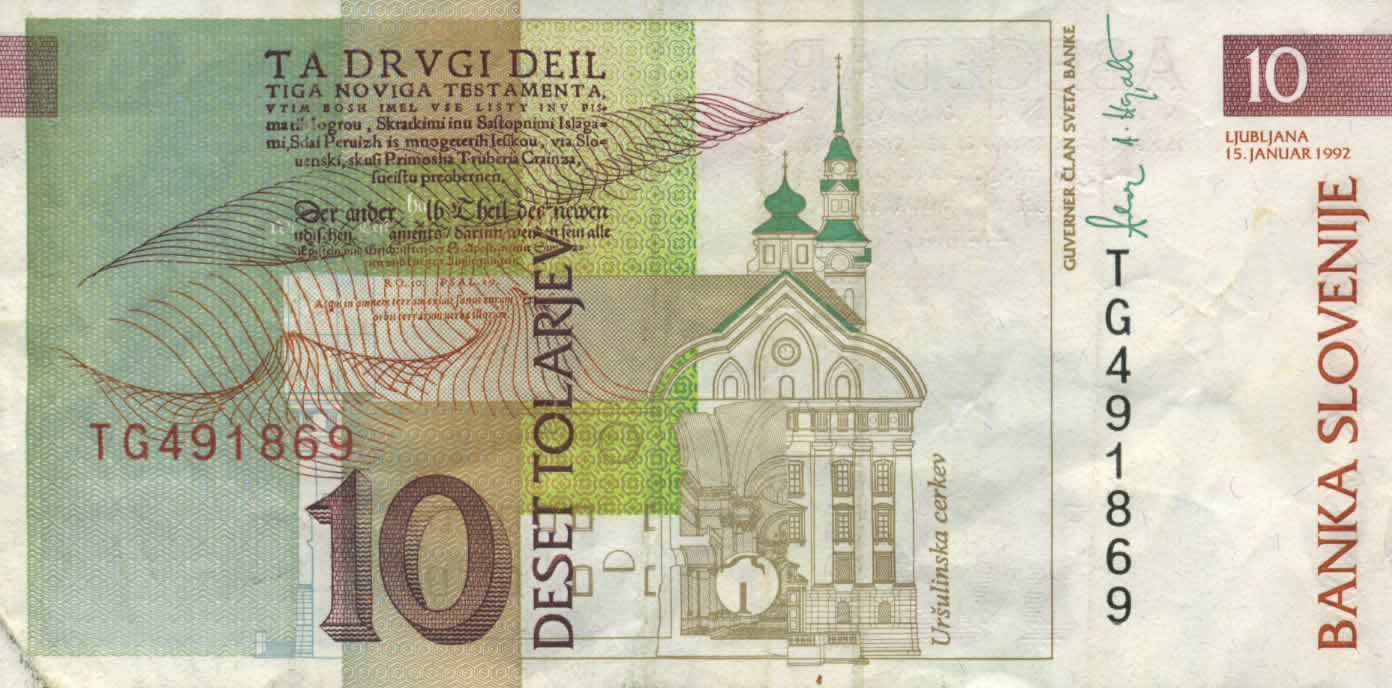
The note above is the 1992 10 Tolarjev note with Primoz Trubar, the author of the first printed book in the Slovene language. the reverse has the Ursuline church in Ljubljana.


Sunday, 24 February 2013

MALTA


The Republic of Malta is an independent parliamentary democracy within the British commonwealth. Its capital is Valletta. The British took possession of Malta in 1814 and retained it until independence in 1964.In 1974 it became a republic and in 2004 joined the EU, adopting the Euro in 2008.

Monetary units:

1 pound = 20 shillings = 240 pence ( up to 1971)
1 Lira = 100 centesimi (up to 2008)
1 euro = 100 cents (2008 onward)

 The 1 lira note above is from 1979 with the Gardjola (watch tower) at Senglea on the front and the new university on the back

Sunday, 17 February 2013

LUXEMBOURG


The Grand Duchy of Luxembourg is bordered by France, Germany and Belgium, with a capital city of Luxembourg. Luxembourg became an independent state and a Grand Duchy in 1815, under the protection of the Netherlands, but in 1839 it lost almost half of its territory to Belgium but gained autonomy. Full independence came in 1867. It was occupied by German forces during both World Wars and ended its neutrality stance by joining NATO in 1949. it was one of the 6 founding countries which formed the European Economic Community- EEC (later the EU) and joined the Eurozone in 1999 adopting the Euro in 2001.

Monetary Units
1 Franc = 100 Centimes ( up to 2001 )
1 Euro = 100 Cents (2001 onward )

The note above is the 5 Franc note from 1944 (ND) featuring Grand Duchess Charlotte on the front and this red coloured reverse  Letzeburg  spelling on the back and the number 5 is spelled Fennef, I am assuming that it is the Luxembourgian language, Luxembourgish, one of the 3 recognised languages - French and German being the others.

Sunday, 13 January 2013

EUROPEAN UNION - EURO


The Eurozone, officially called the euro area, is an economic and monetary union (EMU) of 17 European Union (EU) member states that have adopted the euro (€) as their common currency and sole legal tender. The eurozone currently consists of Austria, Belgium, Cyprus, Estonia, Finland, France, Germany, Greece, Ireland, Italy, Luxembourg, Malta, the Netherlands, Portugal, Slovakia, Slovenia, and Spain. Most other EU states are obliged to join once they meet the criteria to do so.
Monetary policy of the zone is the responsibility of the European Central Bank (ECB) which is governed by a president and a board of the heads of national central banks and the Euro Group, which makes political decisions regarding the eurozone and the euro. The Euro Group is composed of the finance ministers of eurozone states, however in emergencies, national leaders also form the Euro Group.
Monaco, San Marino and the Vatican City have concluded formal agreements with the EU to use the euro as their official currency and mint their own coins. Others, like Kosovo, Montenegro and Andorra, have adopted the euro unilaterally. However, these countries do not formally form part of the eurozone and do not have representation in the ECB or the Euro Group.
In 1998 eleven member states of the European Union had met the Euro convergence criteria, and the Eurozone came into existence with the official launch of the euro (alongside national currencies) on 1 January 1999. Greece qualified in 2000 and was admitted on 1 January 2001 before physical notes and coins were introduced on 1 January 2002 replacing all national currencies. Between 2007 and 2011, five new states acceded.


The Notes above are specimen notes issued to schools for identification purposes. the reverse of the notes all have a map of Europe ( plus french overseas territories ) the front of each note has a different building representing different architectural styles . below are the national identification code letters.


National identification codes
Code Country

Z Belgium
Y Greece
X Germany
(W)(2) (Denmark)
V Spain
U France
T Ireland
S Italy
R Luxembourg
(Q) Not used
P Netherlands
(O) Not used
N Austria
M Portugal
L Finland
(K)(2) (Sweden)
(J)(2) (United Kingdom)
(I) Not used
H Slovenia
G Cyprus
F Malta
E Slovakia
D     Not used
C     Not used
B     Not used
A      Not used         

(2) United Kingdom, Sweden and Denmark are not part of the Eurozone but the letters are reserved for them .


Sunday, 6 January 2013

COMOROS


The Union of Comoros is an archipelago in the Mozambique channel, north west of Madagascar  Although it is termed as a French Collective Territory it gained independence from France in 1975. and although they have their own franc, the Euro is widely circulated.

The top note above, is the 500 franc note from 1976, what puzzles me in this note is that the watermark is a Maltese Cross , which seems strange in a country that is predominately Sunni Muslim. the only connection is to the french Huguenots so possibly that might explain it . Do you know why they would use that symbol?

The second 500 Franc note (red) , is from 2006 and this time the watermark is a crescent moon with 4 stars, which is part of the Flag .

Saturday, 5 January 2013

CENTRAL AFRICAN STATES


The bank of the central African states ( Banque de etats de l'afrique Central - BEAC) is a central bank that covers a regional area with 6 countries involved. Cameroon, Central African Republic, Chad, Congo, Equatorial Guinea and Gabon. This bank took over from the Equatorial African States Bank in 1973 to give more say to the countries involved. Their Franc was pegged to the French Franc. the control of the Bank passed from Paris to Yaounde, the capital of Cameroon, in 1977 and its first African Governor took over in 1978.

The Franc is now pegged to the Euro and has parity with the similar West African states Franc.

the older currency shared a similar reverse side but sometimes the fronts were of a different design. Later the fronts were the same and a Letter signified the actual country of issue ( above top has F in the top right and bottom left (Central african republic) whereas the bottom one has an E there instead (Cameroon) The dates are found by the signatures and the top is from 1994. the bottom one must be after that as the top signature is listed (le Gouverneur ) but the bottom signiture is not listed (un censeur).

From 1993 onwards the country letters are as follows:

Cameroon                            E
Central African Republic        F
Chad                                   P
Republic of the Congo           C
Equatorial Guinea                  N
Gabon                                  L


Above you can see Two of the 500 franc notes from 2002 (date is on the reverse, middle pic, bottom right) . But has anyone spotted the mistake ??? ...... I'll tell you at the bottom of the post!!


now this is the 1000 Franc from Gabon  again from 2002. have you spotted the mistakes ? well they're not really mistakes they are to confuse the forgers .. and me!! In 2002 they changed the Letters . gabon above went fro L to A and the T was for the Republic of congo !! So in now reads:


Cameroon                            E changes to   U
Central African Republic        F changes to   M
Chad                                   P changes to   C
Republic of the Congo          C changes to   T
Equatorial Guinea                 N changes to   F
Gabon                                 L changes to   A

All the changes came in as of the 2002 issue !!
I've had to change my system around 3 or 4 times as i couldn't get my head around it. once you get it, its actually quite easy !!!


Wednesday, 2 January 2013

BELGIUM


Belgium is a constitutional monarchy in western Europe,which became independent from the Netherlands in 1830 and was occupied by Germany in both world wars.the country is made up of mainly 2 peoples, the Flemings - mostly dutch speaking, and the Walloons - french speaking -in the south.

The monetary unit for Belgium, up until 2001 was the Franc, and after the Euro. Above is two notes, the first is a 20 franc note from 1964. it has King Boudouin 1 on the front and the Atomium complex on the reverse.

the second one is the 50 Franc note from 1966. this time King Boudouin is joined by Queen Fabiola on the front and the parliament building on the back.

Tuesday, 1 January 2013

AUSTRIA


Here we have the Republic of Austria, a country in central Europe, which was once the centre of the austro-hungarian empire until world war one. it is now a member of the European union and of the "Euro-zone". Its banknotes were in schillings until 2002 and then Euros since

so if we start at the top the first two pics are of the front and back of a one Krone note from 1919 (as its got a green overprint on the note similar to the 1916 one) this is probably the first issue after the WW1 has finished.

Pic 3 is from 1984 100 schilling note with Eugen Bohm V Bawerk, an Austrian economist, the reverse is wissenschaften academy  Pic 4, from 1986 50 schillings, with Sigmund Freud on the front and Vienna's Josephinum medical school on the reverse. Pic 5 is the 20 schilling note from 1986 with Moritz Daffinger and the Albertina Museum on the reverse.

Pic ^ is a slightly earlier issue from 1970. the 50 schilling note has a portrait of  Ferdinand Raimund , an Austrian actor and the Burg Theatre, Europe's second oldest theatre,  on the reverse.

And finally, the last two pics are front and back of a 20 Kronen note and is  from 1907. i'm assuming that the kronen / korona is because it is from the austro-hungarian empire and that would be the two languages used ???? . I don't have much more info on this one but if someone has more please post it in the comments . TA.