SUB

A TOTALLY AMATEUR BANKNOTE COLLECTOR
Showing posts with label edinburgh. Show all posts

Thursday, 6 October 2016

WELCOME TO THE COLLECTORS EXHIBITION


This blog is part of the above exhibition along with a selection of notes. 
for folks visiting the the exhibition this is the suggestions for using this blog


The countries and currencies are listed on the right ------->>>>>


Click on a country or currency 
E.G Scotland or Baht 


 find a brief history of the country and what notes are there


ENJOY !!  


Tuesday, 1 January 2013

OTHER COUNTRIES IN THE COLLECTION

Well that's Scotland for now, but before we move on, a couple of links that may be helpful.

1. The committee of scottish bankers has a good short history of Scottish banking and they are very helpful if you email them. (the name of the blog is similar but there is no connection). their links page is good too.

2. The museum on the mound is a great place if you are in Edinburgh on holiday (and its free) and has lots of interactive things for kids (and big kids) to play with. the staff are really helpful and, of course, the obligatory gift shop too.

3. The City of Edinburgh Museums , again if you are visiting or live in or around Edinburgh, if you email them when you are going to be in Edinburgh they can make an appointment for you to see some of their collections not on display, including some of the local notes from the last few centuries


Museum on the Mound - Edinburgh, United Kingdom

Museum on the Mound


Bliadhna mhath ur !!

Happy new year !!

Ath bhliain faoi mhaise !!

Happy New Year to everyone !! may all your dreams come true in 2013 


Monday, 31 December 2012

THE ROYAL BANK OF SCOTLAND


The Royal Bank of Scotland plc (Scottish Gaelic: Banca Rìoghail na h-Alba,) is one of the retail banking subsidiaries of the The Royal Bank of Scotland Group plc, and together with NatWest and Ulster Bank, provides branch banking facilities throughout the British Isles. The Royal Bank of Scotland has around 700 branches, mainly in Scotland though there are branches in many larger towns and cities throughout England and Wales. The Royal Bank of Scotland and its parent, The Royal Bank of Scotland Group, are completely separate from the fellow Edinburgh based bank, the Bank of Scotland, which pre-dates The Royal Bank of Scotland by 32 years. The Bank of Scotland was effective in raising funds for the Jacobite Rebellion and as a result, The Royal Bank of Scotland was established to provide a bank with strong Hanoverian and Whig ties.

The bank traces its origin to the Society of the Subscribed Equivalent Debt, which was set up by investors in the failed Company of Scotland to protect the compensation they received as part of the arrangements of the 1707 Acts of Union. The "Equivalent Society" became the "Equivalent Company" in 1724, and the new company wished to move into banking. The British government received the request favourably as the "Old Bank", the Bank of Scotland, was suspected of having Jacobite sympathies. Accordingly, the "New Bank" was chartered in 1727 as the Royal Bank of Scotland, with Archibald Campbell, Lord Ilay, appointed its first governor.
On 31 May, 1728, the Royal Bank of Scotland invents the overdraft, one of the most versatile and imaginative innovations in modern banking. It allows a William Hogg, merchant in the High Street Edinburgh, to take out of his account up to £1000 (£65,449 in today's value) more than he has in it.

(Wikipedia ) for more in depth info see here

THE BANK OF SCOTLAND


The Bank of Scotland plc is a commercial and clearing bank based in Edinburgh, Scotland. With a history dating to the 17th century, it is the second oldest surviving bank (the Bank of England having been established one year before) in what is now the United Kingdom, and is the only commercial institution created by the Parliament of Scotland to remain in existence. It was also the first bank in Europe to print its own banknotes; it continues to print its own sterling banknotes under legal arrangements which allow some UK banks to issue currency.
On 17 September 2007, The Governor and Company of the Bank of Scotland became Bank of Scotland plc, as part of the HBOS Group Reorganisation Act 2006.
Since 19 January 2009, the Bank of Scotland has formed a key part of the Lloyds Banking Group, following the acquisition of HBOS by Lloyds TSB Group.

(Wikipedia) more info here

Sunday, 30 December 2012

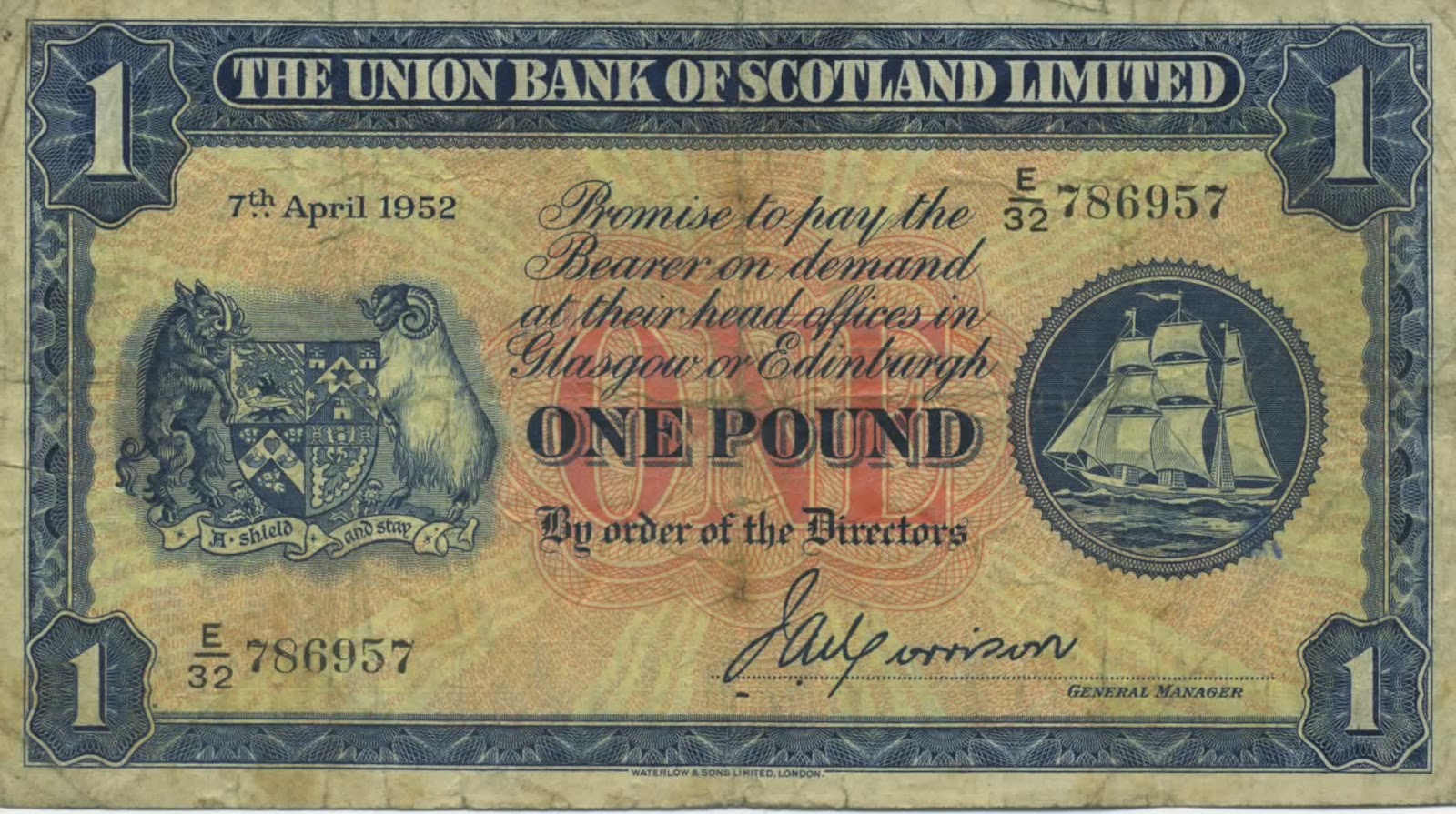
THE UNION BANK OF SCOTLAND


Union Bank of Scotland (1830-1955)
The Glasgow Union Banking Company
The Union Bank of Scotland was established as the Glasgow Union Banking Company, in 1830. It was the first of a number of joint-stock banks set up in the city at that time.
Its capital was set at £2 million, divided into 8,000 shares of £250. More than half the subscription was raised at the first General Meeting, in February 1830.  Detailed analysis reveals that more than 80% of shareholders were based in Glasgow and the west. They were predominantly from the mercantile and manufacturing classes.
The bank's business grew rapidly between 1836 and 1843, primarily as a result of amalgamations. These included the Thistle Bank, Sir William Forbes, James Hunter and Company, the Paisley Union Bank, Hunters and Company of Ayr and the Glasgow and Ship Bank.


In consequence of these mergers, the Company changed its name in May 1843, becoming the Union Bank of Scotland.  This name change reflected the Bank's now national status, both in terms of its geographical reach and its impressive balance sheet. Further amalgamations followed in 1849 (the Aberdeen Banking Company) and 1857 (Perth Banking Company)..


In 1919, it became one of eight banks in the UK to subscribe to the British Overseas Bank. The Union Bank's general manager was appointed chairman of the new body. This left a vacancy that was quickly filled by Norman Hird. He was to become the dominant figure in the Bank for the next 25 years. Aged only 34, Hird was extremely capable. But for all his efforts, it was soon evident that the Bank was in difficulties. Its fortunes were inextricably linked with the rise and fall of heavy industry. It had lent extensively to this sector, which lurched from crisis to crisis for much of the inter-war period.
Despite these troubles, a grand new head office was opened in 1927, at 110 St. Vincent Street, Glasgow. The building was designed by architect James Miller, under the influence of Norman Hird. The latter had travelled extensively in the United States, and was impressed by the architecture of American banks, particularly those on Wall Street in New York.
In the 1930s, the Union Bank explored the possibility of a merger with Bank of Scotland. These early discussions came to nothing, but in 1950, serious negotiations began.  Agreement was reached two years later, and the banks merged in 1955. The St. Vincent Street building became Bank of Scotland's chief office in Glasgow.

WHERE TO BEGIN


There are many reasons why people collect things and, i suppose, banknotes are not that different. some people collect as an investment, to resell later, others so they can find out about other countries and their history, others for the stunning artwork you can find on notes. Whatever your reason for collecting, you must enjoy it!!
Where to start ? well that depends on YOUR reason!! I started with the simple view of ” I’m going to collect at least one banknote from every country in the world” which is a good starting point but soon you realize that countries change their names, divide up, merge, are occupied etc etc. which made it more exciting (and confusing) but has, and will always, keep me interested.
I don’t spend load of money on banknotes, so for me, getting them from the internet has been really useful, general sites like ebay or specialist sites like delcampe or collectors own sites, i find are the best.
A good idea, which i’m going to use here, is to start with your own country. maybe start with the notes circulating now and  work back as they become available. If you live in or near to a large city it may be worth contacting a museum to see if they have a collection you can see – sometimes it may not be on display but they will make an appointment to show it to you – they may know of other collectors in your are that can help. 
we are really lucky in Edinburgh -  i’ll be mentioning a few resources that you can contact as we go along.
Finally, i want to say that i am NOT an academic or expert in any way, so if you see mistakes or you have extra info or contacts, feel free to post them .

I hope you enjoy the Blog !!!!