The Kingdom of Spain, is a sovereign country in south-west Europe, with a capital of
Madrid. The basis for modern Spain was after the fall of the
Moorish control of the area. The unification of the crowns of
Castile and
Aragon. Spain was a leading power in Europe throughout 16th and 17th centuries and was peppered with wars in which Spain went to war with most of its neighbours. This was also the period when Spain expanded it's empire to the Americas and Asia.. A defeat in the
Napoleonic wars saw some of Spain under French control but in 1814 saw the defeat of
Napoleon's army and the return of
Ferdinand VII. these wars left Spain, economically ruined and the wars of independence saw many of the American colonies gain their independence. The
Rif War discredited the government and undermined the monarchy which led to a period of authoritarian rule under General
Miguel Primo de Rivera. The Spanish Civil War broke out in 1936 between the Nationalists led by Franco and the Republicans which were backed by the USSR, Mexico and the
International Brigades.
Franco's forces won and he ruled until 1975. when the country reverted to being led by
King Juan Carlos I, and in 1978 a new constitution was agreed returning the country to a democracy. In 1986 Spain joined the European community (later the EU) and started using the Euro in 2002.
Monetary Unit:
1 Peseta = 100 centimo up to 2002
1 Euro = 100 cents 2002 onwards
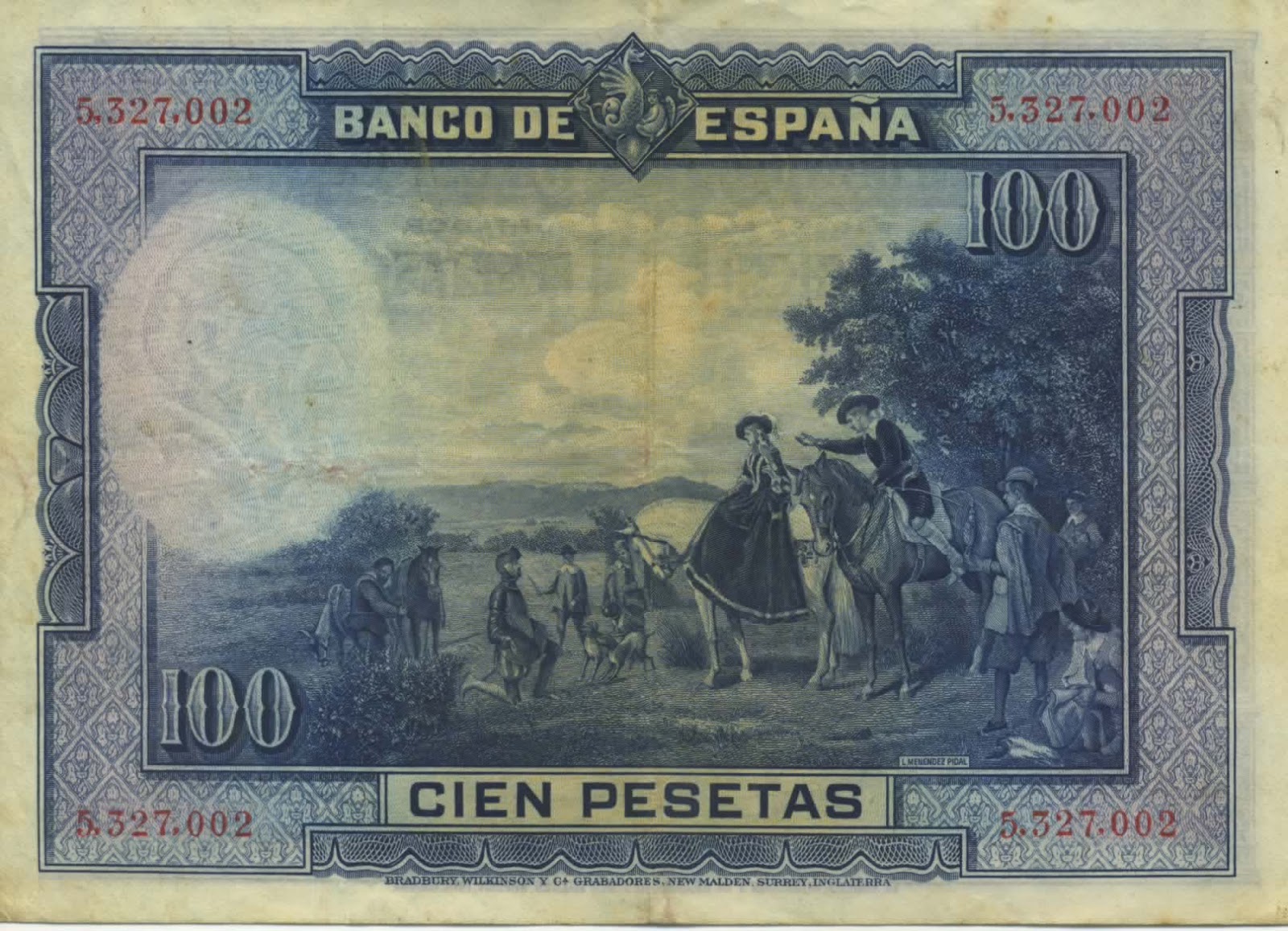
The 3 notes above are from the 1928 issue.The 100 Peseta note has the
Don Quixote monument in madrid, on the front with the head of
Cervantes, the author of
Don Quixote and a painting of Don Quixote by Pidal on the reverse. the 50 Peseta note has the
Prado museum along with the bust of
Diego Velazquez on the front and the painting by Velazquez "
La rendicion de Breda" on the reverse. the 25 peseta note has the bust of
Pedro Calderon de la Barca with his
monument in santa ana square, Madrid on the front and a scene from one of his plays on the reverse.
I love the art work on these notes and that they are a slightly different shape to other notes, but also front and back have different colour schemes. I think these stand up as works of art in their own right.
The next two notes, above takes us into the 1950's. The 50 Peseta note, from 1951, has Sadiago Rusinol, a Catalan painter, on the front and his painting "Jardines de Aranjuez" on the reverse. the 1954, 25 Peseta note has
Isaac Albeniz, the Spanish composer on the front and the
Court of the Lions in the
Alhambra on the reverse.
The note above is a 1992 issue of the 2000 Peseta note. It features the Spanish Botanist and priest,
Jose Celestino Mutis, on the front and the
botanical gardens on the reverse
This note above is from the Spanish civil war issued by the Igualada co-operative in barcelona in 1938. as banknotes were scarce, quite often areas would produce their own notes.
Above is the very unusual 1938 postage stamp / disk issue in which they used a cardboard dick stamped on one side in ink and attache a postage stamp to the other. these were issued towards the end of the Spanish Civil War.