this is the 100 peso note from Mexico. it was issued in 1982. the front has Venustiano Carrnza, a leader of the mexican revolution, with a stone figure on the reverse.
Above are two notes from Argentina . The first is the 1000 pesos from the 1966-69 issue with General jose de san martin , a leader in the independence movement in south america against the spanish empire. It also has a picture of a sailing ship on the reverse.
the second note is a one peso note from the 1908-25 issue and has "liberty" on the front and under the "Un Peso" there is a box with a watermark and the way it is written helps date the note. they all have 1 peso but it is the way the P and E is written that decides.
you can see more notes from Argentina HERE and HERE
I love the colours in this note they make it stand out from other notes. It is the 5 Peso note from the Dominican Republic in the Caribbean. Francisco del Rosario Sanchez features on the front and the Presa del Valdesia hydroelectric dam on the reverse.
Here we have a 100000 peso note from Bolivia. this note was issued in 1984 and has a "campesino" or an indigenous Indian man. on the reverse it has a picture of some agricultural machines and the words "reforma agraria" or agrarian reform in English
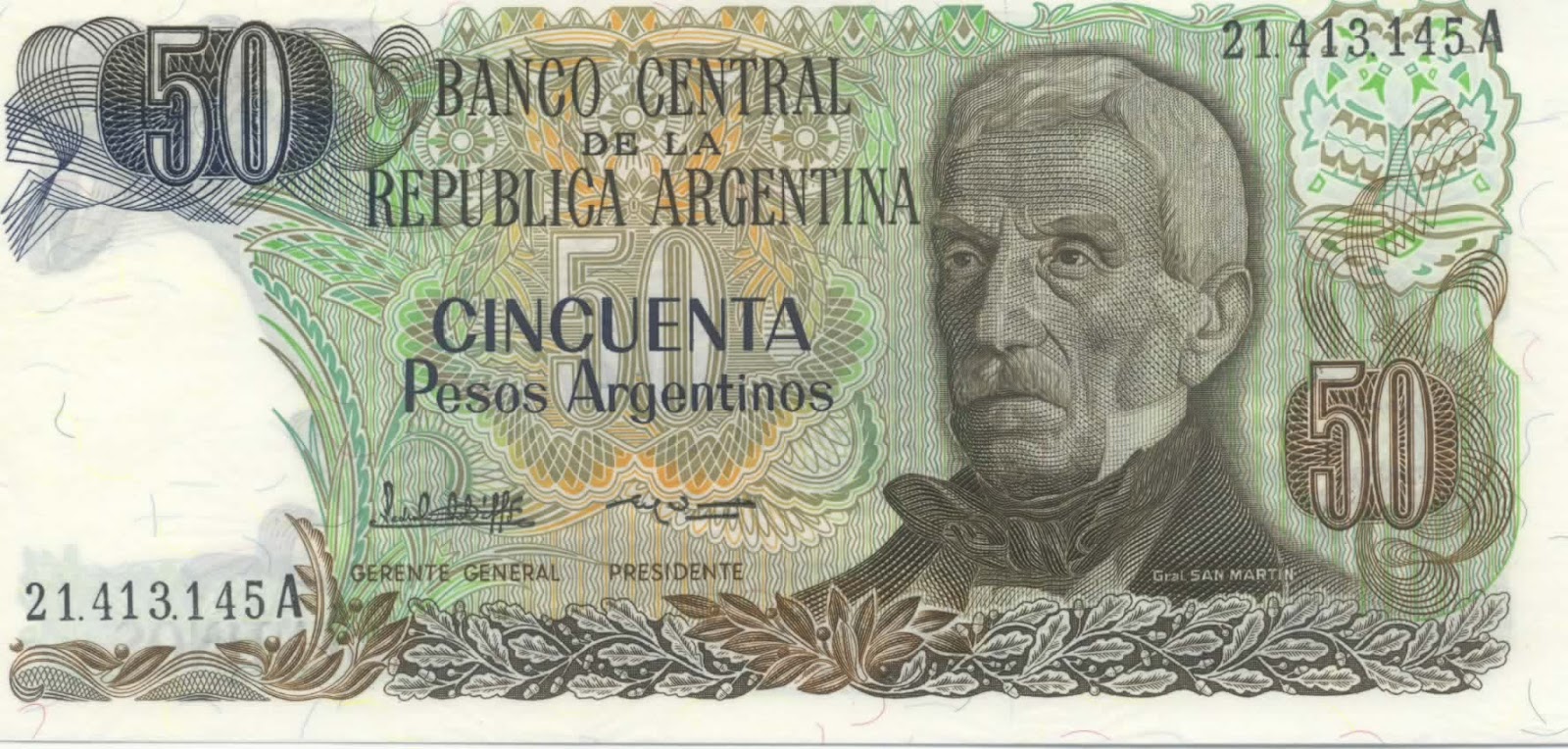
Here is a 50 peso note from Argentina and was issued in the batch from 1976-78. The front has Jose de san Martin one of the main liberators of South America and a contemporary of Simon Bolivar . the reverse has the hot springs from the province of Jujuy.
This is the 1000 peso note from Chile. It has Ignacio Carrera Pinto on the front and the Torres del Paine national park on the reverse. The 1000 peso is the first in a series of 4 banknotes in this issue. the note is from 2012.
MANILA - How many peso bank notes and coins are there in the Philippines?
According to the National Statistical Coordination Board (NSCB), the combined length of the country's banknotes -- if these were connected end to end -- is enough to go nine times around the earth’s equator or nearly the distance of the earth to the moon.
NSCB Secretary-General Jose Ramon G. Albert said the country had 2.32 billion pieces of notes valued at P603.64 billion as of last June.
Laid down end-to-end, the banknotes would run to more than 371.2 thousand kilometers – equivalent to 100 time the length of the Pan-Philippine National Highway, which extends from Laoag City in Ilocos Norte to Zamboanga City in Mindanao.
There are two sets of banknotes issued by the Bangko Sentral ng Pilipinas (BSP) and in use today: the New Design Series (NDS) and the New Generation Currency (NGC). The NDS has been in use for more than a quarter of a century while the NGC has been in use starting December 2010.
To thwart counterfeiters, the NGC features improved security features which include embossed prints, security fibers, watermark, see-through mark, and others.
The NGC shall eventually replace the NDS once the latter is demonetized. In the meantime, both are legal tender.
Apart from banknotes, the Philippines had 20.08 billion pieces of coins in circulation worth a combined P22.77 billion as of June this year.
More than half or 56.6 percent of these are lower denominated coins. Coins in circulation are the following: one centavo, five centavos, 10 centavos, 25 centavos, one peso, five pesos and 10 pesos.
Citing BSP estimates, Albert said the number of coins is equivalent to 207 pieces of coins per Filipino.
But, is there a shortage of coins?
"Believe it or not, the Philippines does not have a shortage of coins," Albert said.
"The BSP explains that occasionally, there is an artificial shortage of coins due to the habit of people of keeping coins in wallets, drawers and piggy banks instead of using them as payment for goods and services, or depositing them in banks," he said.
In the case of one-peso coins, there is high demand because of the popularity of "coin games," which interfere in the circulation of coins throughout the economy, Albert said.
In the past, the BSP and the Bureau of Customs recorded attempts to smuggle out one-peso coins and in some cases, they are hoarded for melting and export, Albert said.
As per Republic Act No. 7653, otherwise known as the New Central Bank Act, the BSP has the sole power and authority to issue currency within the Philippine territory. The BSP not only issues Philippine peso banknotes and coins for general circulation but also commemorative notes and coins which are legal tender as well.
The Free and Sovereign State of Chihuahua, is one of the 32 Federal entities of Mexico. Its capital city is Chihuahua. In 1872, Porfirio Diaz took power in Mexico and ruled as a dictator over the next 4 decades. diaz undid lots of the Land reforms put in place to empower the small farmers and peasants which led to the Mexican Revolution which threw up leaders such as "Pancho Villas", Zapata and Madero.
Monetary unit: Peso
The 5 Peso Note above is from the State of Chihuahua is from 1914. This bank note was produced by Pacho Villa while he was governor of the state of Chihuahua and has two men who he admired on the front - Francisco Madero, 33rd president of Mexico and Abraham Gonzales, the previous governor of Chihuahua and Villa's political mentor.
The Oriental Republic of Uruguay, is a country in South America with a capital city of Montevideo. Early colonisation of the area, inhabited by the Charrua people, started in the early 1500's with both Spain and Portugal fighting for control of the area that is now Uruguay and Argentina. In 1811, there was a successful revolution against the Spanish colonialists. This revolution freed most of Argentina and Uruguay but war between the two delayed Uruguay's independence until 1828. The early 20th century saw conflict between the conservative Blancos and the liberal Colorados and in 1973 a military coup d'etat brought the country under military rule until 1984, when national elections were held.
Monetary Units:
1 Peso = 100 centesimos (1860 - 1975)
1 Nuevo Peso = 1000 old peso (1976 - 1993)
1 Peso Uruguayo = 1000 Nuevo Peso (1993- onward)
The wonderful note above is the 1998 issue of the 5 Peso Uruguayo note Featuring Joaquin Torres Garcia, a Uruguayan artist, on the front and one of his paintings , pintura constructiva (1943) on the reverse.
The Republic of the Philippines is an archipelago in South East Asia, with a capital city of Manila. In 1571, The territory, plus some other islands including Formosa (Taiwan) was colonised by Spain and renamed Spain East Indies. after the Spanish-American war in 1898, The first Philippine Republic was set up but not recognised by America which led to the Philippine-American war in which america took control of the territory.In 1935, The USA gave the country "commonwealth Status" with the idea of moving towards full independence but the second world war broke out and the Philippines were invaded by the Japanese, who stayed until defeated at the end of the war in 1945. the following year the Philippines gained its independence.
monetary units:
1 peso = 100 centavos up to 1967
1 Piso = 100 sentimos 1967 onward
The Notes above are the 2 and 1 Piso notes. the 2 Piso note is from 1981 commemorative issue, with Jose Rizal, a national hero, on the front and a picture of Aquinaldo's declaration of independence on the reverse. The 1 Piso note has a younger Jose Rizal and a different scene from the declaration of independence.
There is a town in the Netherlands called Philippine , it's nothing to do with the country but has nice mussel restaurants apparently!!
The United States of Mexico, with it's capital, Mexico city, is the most northerly country in central america.Mexico has been the home of some of the most advanced civilisations of their time up until the Spanish conquistador Hernando Cortes defeated the Aztec emperor Montezuma in 1521. the Spanish Colony, then called New Spain, lasted for 300 years and stretched from modern day Guatemala to the southern states of the USA . The present borders being formed after the 1846 -48 war with the united states.
Independence was declared in 1810 by Father Maguel Hildalgo but actually achieved in 1821 by General Augustin de Iturebide, who declared himself emperor for a year before being deposed to set up a republic in 1822. after many years of turmoil and dictatorships , Mexico is now a stable democracy.
The note above is the 1963 5 Peso note, with a gypsy girl on the from and the independence monument on the reverse.
The Republic of Guinea - Bissau is a former Portuguese colony on the west coast of africa with its capital city as Bissau. Guinea - Bissau was part of the Mali empire until the 19th century when it became a colony of Portugal it gained independence in 1974 and added the capital city's name to the country's to stop any confusion with the neighbouring state of Guinea.
The two notes above are both from the 1990 issue. the 100 Pesos note has Domingo Ramos , a freedom fighter, on the front and the national bank building on the reverse. whereas the 50 pesos note has Pansau na isna on the front with a village scene on the reverse.
OK, this is the one I was looking forward to, and dreading !! Looking forward to because Cuba is a place I have visited and love, and therefor have collected loads of banknotes from there, hence the dread. Fair Warning !!! This may be a very long post - you may need a little Mojito to help you through!!!
I'll try and do it in little chunks so as its more accessible. first we'll start with a bit about the country and then the notes - oldest first.
The Republic of Cuba is a large island south of Florida in the united states, with its capital city Havana synonymous with, communism, cigars, and Salsa (and other dances) not necessarily in that order. the first European to discover Cuba was Christopher Columbus in 1492 and Cuba became a Spanish colony from then until the Spanish-American war in 1898. Full independence came in 1902. Fidel Castro led his rebel army to victory in 1959 and the communist state was born. In the early 1990's the Soviet Union collapsed and their backing fr Cuba disappeared and adding to the problem the illegal american blockade of Cuba caused what Cubans called the Special period, which was a period of severe hardship for Cubans. Out of the special period, the Cubans changed from the soviet way of massive state farms to the development of smaller organic and Permaculture farms to feed the population.
on February 2008, Fidel Castro resigned from the presidency and his Brother, Raul was elected president one month later.
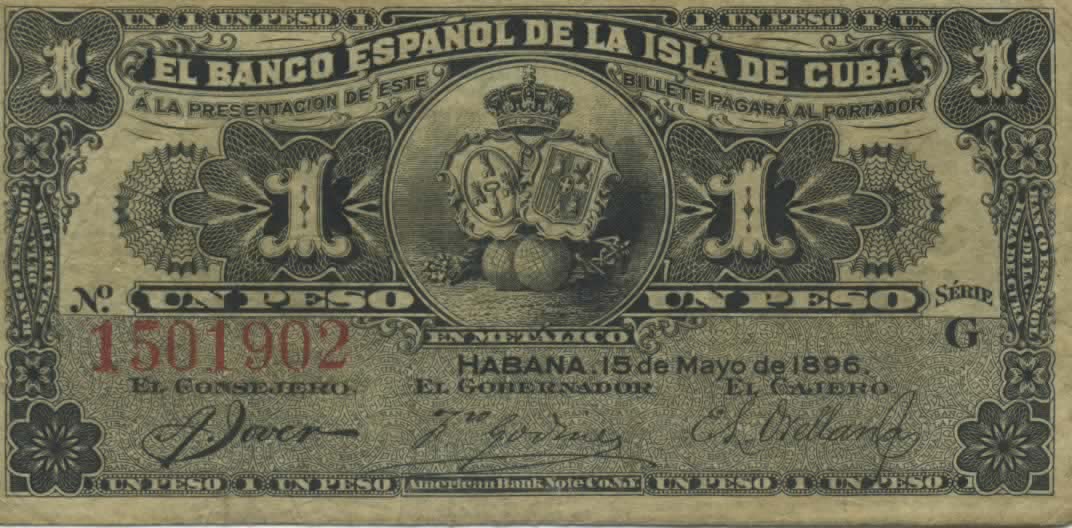
These old notes all come from the 1996 / 97 era which was around the time of the Spanish-American war. someone must have thought that the 5 centavos note looked better with rounded corners !! so we have 5 , 10, 20 and 50 Centavos and the 1 peso. the 10c and the 20 c both from 1897 have a ship and people harvesting sugar cane, respectfully. whereas the 5c and 50c have tobacco plants on the reverse and are from 1896. The 1 peso, also 1896, has a portrait of Queen Regent Maria Cristia on the reverse.
This next batch are all from the pre-revolutionary Cuba in the 1950's. the first one is the 100 Peso note from 1959 (which is after the revolution had happened - castro gained power on the 1st january 1959 but making new notes takes time!!) . It has a picture of Francisco Vicente Aguilera . The 50 Pesos note is from 1950 and sports Gen. Calixto Garcia Iniguez a fighter in the first wars of independence. The 20 peso note, with Antonio Maceo, a hero of the wars of independence and second in command of the Cuban army, he is still often referred to in modern day Cuba.
the 10 Peso note 1956 has another Cuban freedom fighter called Carlos Manuel de Cespedes - a name i have not come across as yet - a lot of these men seemed to be rich landowners who freed their slaves and then sunk all their money into fighting for independence. Another freedom fighter, Maximo Gomez, appears on the 5 peso note from 1968 and , Finaly for this section, the great man himself, Jose Marti, this man has statues everywhere in Cuba and everyone knows everything about him. he is up there with Fidel and Che when it comes to men that Cuban revere. As well as being a fighter he was also a political analyst and a poet. he is portrayed here on the 1 peso note from 1958.
and as a little cultural aside here is one verse of one of his poems.
I HAVE A ROSE TO TEND
I have a white rose to tend
In July as in January;
I give it to the true friend
Who offers his frank hand to me.
And for the cruel one whose blows
Break the heart by which I live,
Thistle nor thorn do I give:
For him, too, I have a white rose
Jose Marti
The 4 notes above, from the 1960 issue, are two different issues of the 10 and 5 peso note in the same year the 10 sport the same pictures as the ones above but the gentlemen moving to the middle of the note in the second ones.
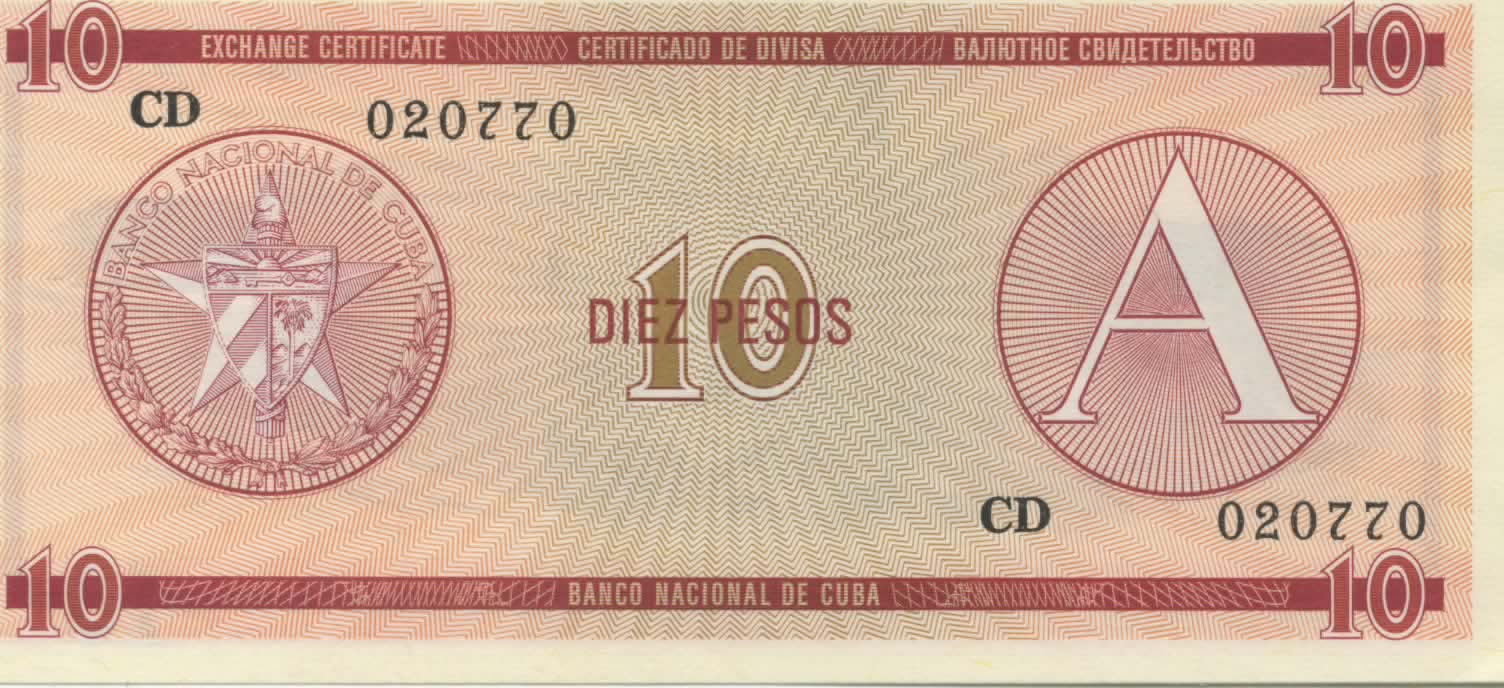
The above Foreign Exchange certificates are issued over 4 series A-D with C and D having two issues. series A and B both are from 1985 where as the C and D issues have no date registered (that I can find) For those of you with Hawk-like eyes you may notice that the A and B series have the " exchange certificate " written along a strip at the top of the note, in English, Spanish and Russian, but bythe D series the Russian has been dropped and replaced by French (?) . does that mean it was after 1991 when the soviet bloc collapsed?
And now up to more modern currency. The two 1 Peso notes above are from 2007 and 1994 respectfully. the top one has Marti on the front and a scene from Casto's victorious entry to Havana in 1959 on the reverse. The second one from 1994 would have been issued during the Special Period, ahs the Marti monument in Havana on the front and the cuban coat of arms on the reverse.
and Finally, finally, finally, the one all the tourists want to get - the 3 peso Note with a picture of Ernesto "Che" Guevara. From 2004 with Che in the sugar cane fields on the back.
Well That wasn't as bad as i thought it would be , and I kept the politics to a minimum I will do another post later about the dual system that Cuba has at the moment.