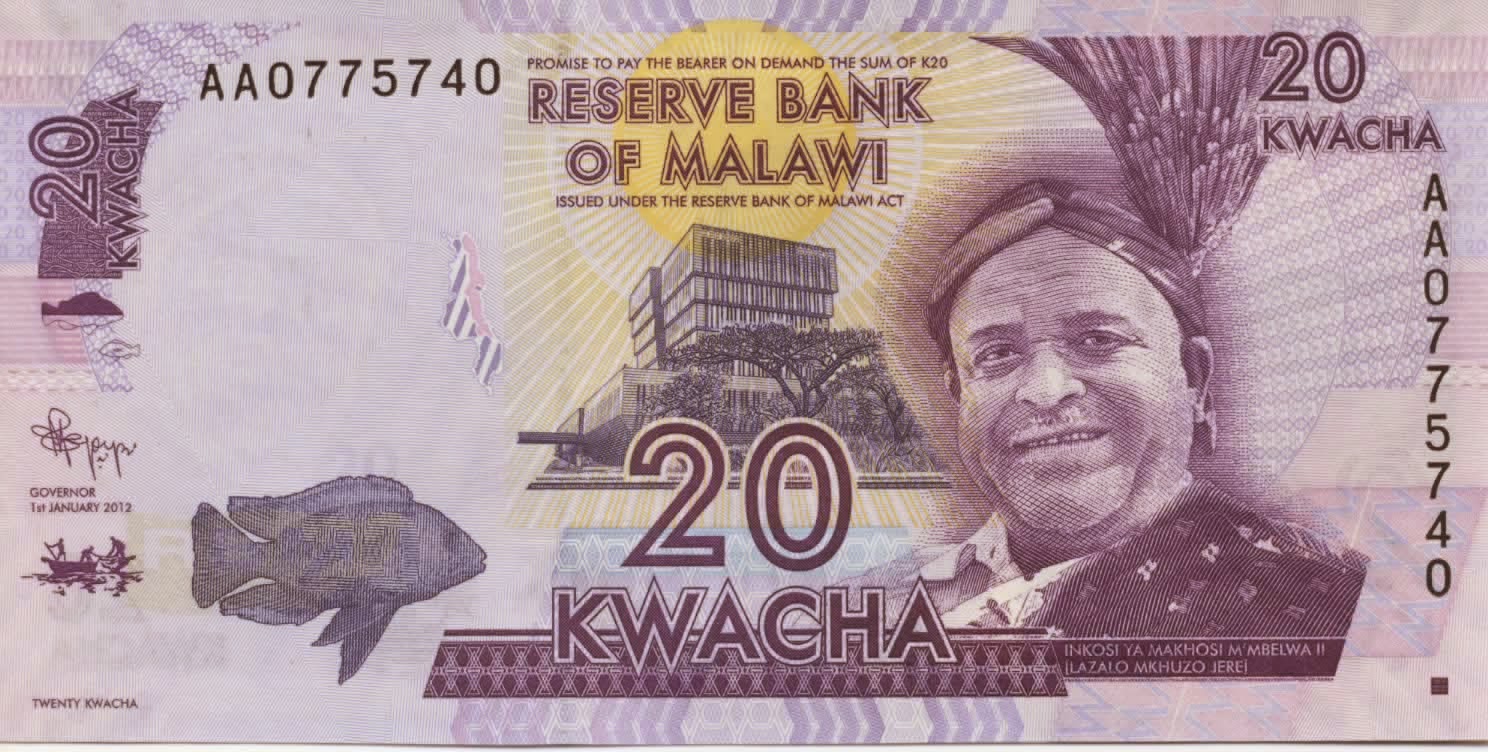
This note was actually found down the back of my sofa !!! it must have slipped out of a batch of notes I had bought. The amazing thing is that it is still in pristine condition.
I'm being a bit lazy but here's how the
reserve bank of Malawi describes this note:
The front;
Inkosi Ya Makhosi M’mbelwa II – Lazalo Mkhozo Jere (K20 banknote)
Lazalo Mkhuzo Jere (1902 – 1959). He went to school at the
Free Church of Scotland Mission station of Loudon or Embangweni between 1915 and 1920. He was installed as Paramount Chief of the Northern or Jere Ngoni in 1928. His thirty-one years on the throne saw him emerge as a development conscious leader, and he was to go down in history as the most powerful and fearless king the
Jere Ngoni have had since they settled in northern Malawi in the mid nineteenth century.
M’mbelwa II endeared himself to his people by his cultural sensitivity and taste. This is because at a time of creeping westernization in dress and mannerisms, he took pride in being dressed with a touch of tradition: a colourful toga thrown over his shoulders and a headdress which spotted a plume (uluvi).
He effectively lobbied for the establishment of the Kasitu Valley Milk, the Ghee Cooperative Society in 1948 and the development and exploitation of the natural resources in the Viphya Plateau. The latter resulted in the launching, with the assistance of the Commonwealth Development Corporation, of the Viphya Tung Plantations Project in 1952.
He led his people to oppose the imposition of the
Federation of Rhodesia and Nyasaland in the early 1950s. He established auxiliary schools for the poor in 1957 based on the Ghana model and provided scholarships to the needy under the M’mbelwa Bursary Scheme. In the late 1950s, he mobilised the people of
Mzimba District to rally behind the
Nyasaland African Congress leader
Dr. H. Kamuzu Banda, and the movement for national independence. He was one of the five Chiefs who went to protest against the imposition of the Federation of Nyasaland and Rhodesia in 1953 at Lancaster House, United Kingdom in 1953.
M’mbelwa II died after a short illness, of diabetes, in 1959. He was mourned in grand style by the Ngoni from Mzimba, Ntcheu and Chipata in Zambia; as well as leaders and friends of Nyasaland African Congress from all parts of the country.
and the reverse;
K20 note
The back of the K20 banknote has the Machinga Teachers Training College in
Machinga representing the theme of Social Development (sub theme Education). Next to the motif is a pile of books and a graduation cap symbolising availability of learning materials and high levels of education, respectively.
More on
Malawi here