This note is the 10 gulden note from 1968 with Frans Hals , the dutch painter, on the front and a modernistic design on the back.there are two versions - in the top left of the reverse side is two circles one is a cross fire , one version has a zero in it, the other has no zero (as above)
I have to admit that I love notes from Suriname, they are so colourful and great designs. This one is a 100 gulden note from 1982 . the reverse has the presidential palace in the capital city Paramaribo.
These two notes from Suriname, in South America , are examples of two jargon words in collection banknotes.
The 25 Gulden is a "Filler" or a lower condition note that you have until you find an uncirculated one. This one is from 2000 and is part of a collection with flowers on the front and birds on the reverse. This one has the Cannonball tree flower and the white throated toucan on the reverse. Handy, as they have given the Latin names on the note !!
The Second note is a 10 Gulden note and is a "doubler" where you already have one and receive a second one. you can see a description and other Suriname notes HERE
This is a 1 Gulden note from the Netherlands (Holland) dated 1938. the queen's head on the front left of the note is Queen Wilhelmina, who was the longest reigning dutch monarch (1890 - 1948) on the reverse is the national coat of arms.
The Republic of Suriman is a country in the northern part of South America. Its capital city is Paramaribo. The Society of Suriname was formed to administer the area in 1682. the society was made up of a Dutch family, the Dutch west Indies company and the city of Amsterdam. the mainstay of the country was the plantations and slaves. The abolition of slavery in 1863 saw the Plantation slaves freed but were not fully released until 10 years later. In 1973 , the local government started negotiations with the Netherlands which led to independence two years later in 1975. 1980 saw a military coup d'etat which announce the country as a socialist republic. In 1987 an election was held and a civilian government took control but the leader of the army dismissed the government by telephone in 1990. there followed a guerilla war between the army and the Maroons.
Monetary unit:
1 Gulden = 1 florin = 100 cents (up to 2004)
1 dollar = 100 old Gulden (2004 onwards)
The note above is the 1985 25 Gulden note with soldiers led by a woman on the front and the Presidential palace on the reverse.
The Netherlands is one constituent country that make up the Kingdom of The Netherlands. the other 3 being Aruba, Curacao and Sint Maarten. It is often referred to as Holland but north and south Holland are only 2 of the 12 provinces (plus 3 special municipalities in the Caribbean) the latin name for this is " pars pro toto" - part taken for the whole. The capital city is Amsterdam.
monetary unit:
1 gulden = 100 cents ( up to 2001)
1 euro = 100 cents (2001 onward)
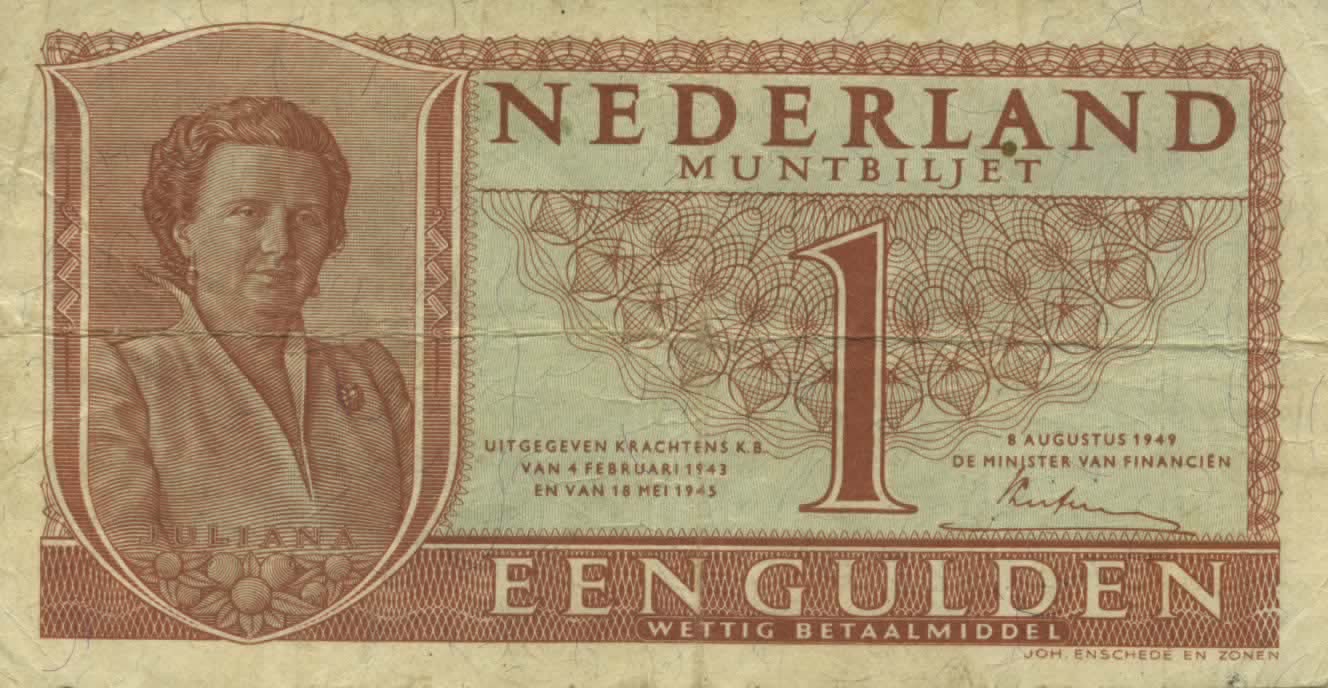
The note above is the 1949 1 gulden note with a portrait of Queen Juliana on the front.
The Netherlands East Indies, sometimes called the Dutch East Indies, was a Dutch colony which is now Indonesia. The colony came under Dutch control from the Dutch east Indies company in 1800. In 1942, during world war II, the Japanese occupied the territory and after the war finished local nationalists demanded and got the territory returned to them and formed Indonesia.
The note above is a Japanese occupation note from 1942, it is a ten Gulden note with a banana tree on the front and coconut palms on the reverse
The Netherlands Antilles, sometimes referred to as the Dutch Antilles, was a constituent country within the kingdom of The Netherlands. It came into effect in 1948 and lasted until it was finally dissolved in 2010. the constituent parts were the islands of Aruba, Curacao and Sint maarten - which went on to be independent countries within the Netherlands - and Bonaire, Sint Eustatius and Saba which were incorporated into The Netherlands.
monetary unit: 1 gulden = 100 cents
The Note above is the 1 (een) gulden from 1970 with a view of a harbour on the front and the crowned arms on the reverse.
Curacao is an Island of the Venezuelan coast and is now part of the Netherlands Antilles and therefor part of the Netherlands. It produced its own money from 1855 through to 1960 after which it used the Netherlands Antilles notes. Its Capital is Willemstad .
The note above is the 1942 1 Guilden with mercury on the from and the coat of arms on the reverse.