SUB

A TOTALLY AMATEUR BANKNOTE COLLECTOR
Showing posts with label royal bank of Scotland. Show all posts

Monday, 29 September 2014

ROYAL BANK OF SCOTLAND £5


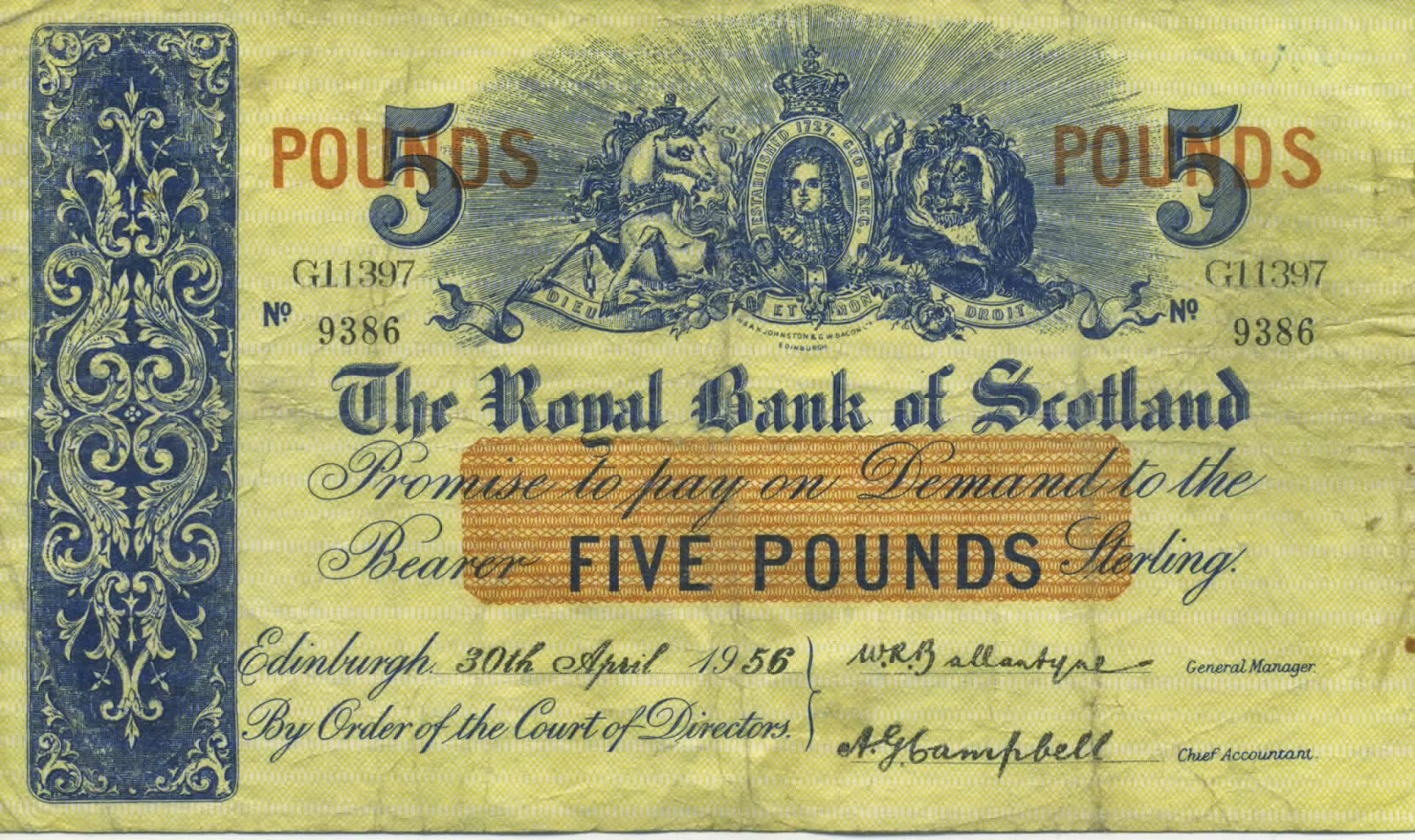
This one is one i got excited about - I know getting excited about an old out-of-date fiver is sad !! I haven't added any new Scottish notes for ages. This is a 5 Pound (£5) from the Royal Bank of Scotland and dated 1956 and is uniface i.e. the back is blank.

Rather than the signatures, which usually define the date of the note (other than when it is printed on it ) in this case it is the printer that is significant. This note it has W and AK Johnstone and G W Bacon ( you can see it just below the crest in the top middle of the note) if it has just AK Johnstone LTD it is more desirable and therefore more expensive and if it has the first one with LTD added to G W  Bacon its the most desirable of all, demanding a premium amount !!


Lord provost of Edinburgh (1848-51)

One of the founders of the printing company above became Lord provost of Edinburgh - sort of like a Mayor for 4 of the biggest Scottish cities.

Monday, 31 December 2012

THE ROYAL BANK OF SCOTLAND


The Royal Bank of Scotland plc (Scottish Gaelic: Banca Rìoghail na h-Alba,) is one of the retail banking subsidiaries of the The Royal Bank of Scotland Group plc, and together with NatWest and Ulster Bank, provides branch banking facilities throughout the British Isles. The Royal Bank of Scotland has around 700 branches, mainly in Scotland though there are branches in many larger towns and cities throughout England and Wales. The Royal Bank of Scotland and its parent, The Royal Bank of Scotland Group, are completely separate from the fellow Edinburgh based bank, the Bank of Scotland, which pre-dates The Royal Bank of Scotland by 32 years. The Bank of Scotland was effective in raising funds for the Jacobite Rebellion and as a result, The Royal Bank of Scotland was established to provide a bank with strong Hanoverian and Whig ties.

The bank traces its origin to the Society of the Subscribed Equivalent Debt, which was set up by investors in the failed Company of Scotland to protect the compensation they received as part of the arrangements of the 1707 Acts of Union. The "Equivalent Society" became the "Equivalent Company" in 1724, and the new company wished to move into banking. The British government received the request favourably as the "Old Bank", the Bank of Scotland, was suspected of having Jacobite sympathies. Accordingly, the "New Bank" was chartered in 1727 as the Royal Bank of Scotland, with Archibald Campbell, Lord Ilay, appointed its first governor.
On 31 May, 1728, the Royal Bank of Scotland invents the overdraft, one of the most versatile and imaginative innovations in modern banking. It allows a William Hogg, merchant in the High Street Edinburgh, to take out of his account up to £1000 (£65,449 in today's value) more than he has in it.

(Wikipedia ) for more in depth info see here