SUB

A TOTALLY AMATEUR BANKNOTE COLLECTOR

Sunday, 23 March 2014

MALAWI DISCOVERED AGAIN


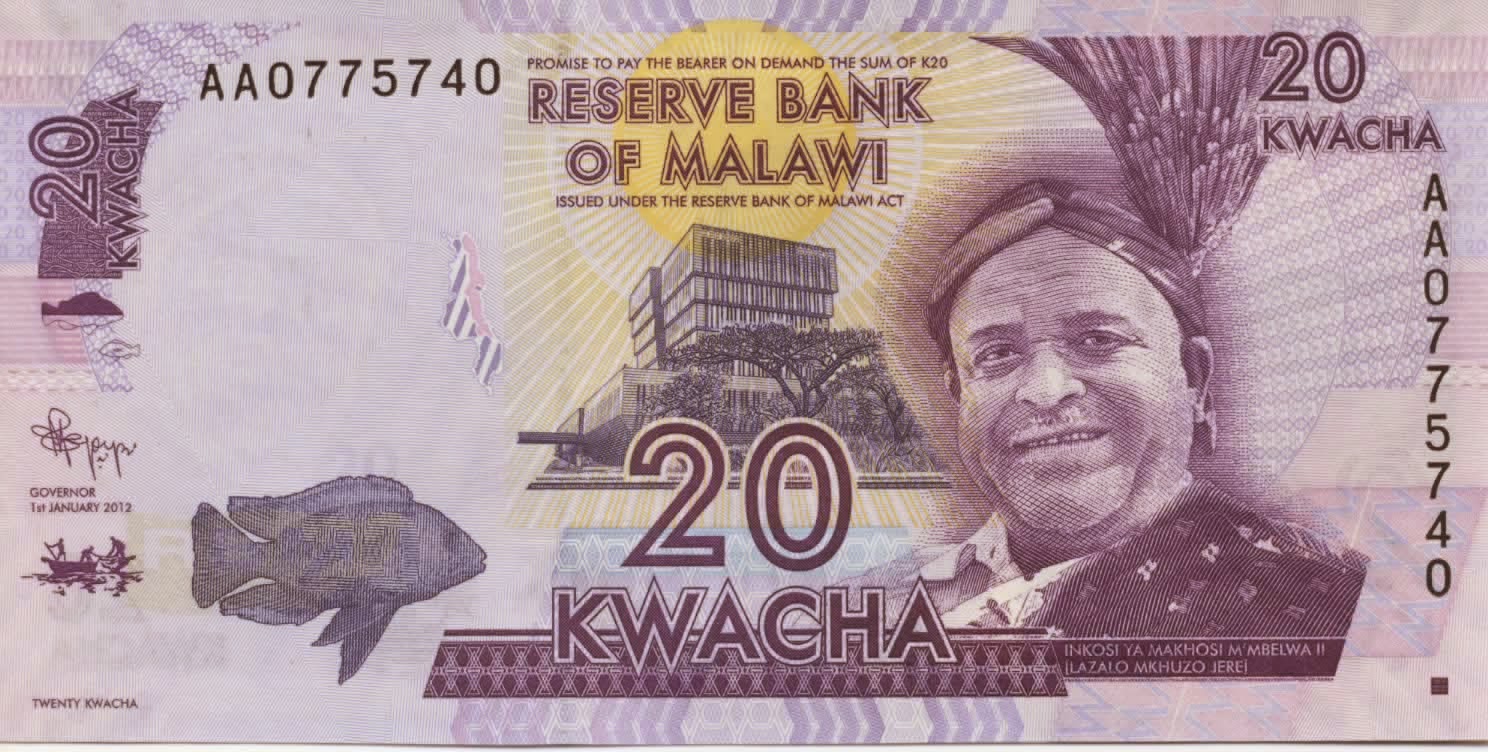
This note was actually found down the back of my sofa !!! it must have slipped out of a batch of notes I had bought. The amazing thing is that it is still in pristine condition.

I'm being a bit lazy but here's how the reserve bank of Malawi describes this note:

The front;

Inkosi Ya Makhosi M’mbelwa II – Lazalo Mkhozo Jere (K20 banknote)
Lazalo Mkhuzo Jere (1902 – 1959). He went to school at the Free Church of Scotland Mission station of Loudon or Embangweni between 1915 and 1920. He was installed as Paramount Chief of the Northern or Jere Ngoni in 1928. His thirty-one years on the throne saw him emerge as a development conscious leader, and he was to go down in history as the most powerful and fearless king the Jere Ngoni have had since they settled in northern Malawi in the mid nineteenth century.

M’mbelwa II endeared himself to his people by his cultural sensitivity and taste. This is because at a time of creeping westernization in dress and mannerisms, he took pride in being dressed with a touch of tradition: a colourful toga thrown over his shoulders and a headdress which spotted a plume (uluvi).

He effectively lobbied for the establishment of the Kasitu Valley Milk, the Ghee Cooperative Society in 1948 and the development and exploitation of the natural resources in the Viphya Plateau. The latter resulted in the launching, with the assistance of the Commonwealth Development Corporation, of the Viphya Tung Plantations Project in 1952.

He led his people to oppose the imposition of the Federation of Rhodesia and Nyasaland in the early 1950s. He established auxiliary schools for the poor in 1957 based on the Ghana model and provided scholarships to the needy under the M’mbelwa Bursary Scheme. In the late 1950s, he mobilised the people of Mzimba District to rally behind the Nyasaland African Congress leader Dr. H. Kamuzu Banda, and the movement for national independence. He was one of the five Chiefs who went to protest against the imposition of the Federation of Nyasaland and Rhodesia in 1953 at Lancaster House, United Kingdom in 1953.

M’mbelwa II died after a short illness, of diabetes, in 1959. He was mourned in grand style by the Ngoni from Mzimba, Ntcheu and Chipata in Zambia; as well as leaders and friends of Nyasaland African Congress from all parts of the country.


and the reverse;

K20 note
The back of the K20 banknote has the Machinga Teachers Training College in Machinga representing the theme of Social Development (sub theme Education). Next to the motif is a pile of books and a graduation cap symbolising availability of learning materials and high levels of education, respectively.


More on Malawi here

FRENCH ANTILLIES (FRENCH WEST INDIES)


The French Antilles or French West Indies, are made up of 7 territories under French sovereignty - Guadeloupe and Martinique (french overseas territories), Saint Martin and Saint Barthelemy (French overseas dependencies) and the three island dependencies of Guadeloupe - Les Saintes, Marie Galante, La Desirade. The french Antilles issued its own currency from 1961 until 1975 when the French currency took over and presently it uses the Euro.

Monetary unit : 1 Franc = 100 Centimes

I have been trying to get this note for ages but most people want stupid money for it but i managed to get this one within my price range.

It is a 10 franc note from 1964 (ND) . the front has a a woman with the shoreline behind her and the reverse has a banana harvest with people harvesting in the foreground and a factory in the background.Again the French go for a really artistic note with beautiful colours.

** wikipedia seems a bit confused as to whether French Guiana is included in the currency but as you can see in the scan it says - from top left- the departments of  Guadeloupe, Guyane and Martinique.


See also FRANCE , GUADELOUPE, MARTINIQUE

DANZIG


The Free City of Danzig was created by the treaty of versailles which lasted between the two world wars. It was made up of the city of Danzig - today called Gdansk - and 200 towns in the area surrounding the city. Previously it was part of Prussia , West Prussia and the Weirmar Republic and existed between 1920 and 1939. The city was administered by the local nazi party from 1933 until 1939 when the Yalta conference decided it should be part of Poland.

Monetary Unit: 1 Mark = 100 pfennig

The Notes above are the emergency money issued in 1919 as the city state was being set up and was issued by the city council.

The notes are the 50 and 10 Pfennig notes and both are uniface.

see also Poland and Germany

Monday, 27 January 2014

BURMA UNDER JAPANESE OCCUPATION


The Japanese Occupation of Burma, during World War II, lasted from 1942-1945. It ended when anti-fascist nationalist army, under the command of  Aung San, rose up and expelled the japanese forces from Burma. It was then, that independence talks begun with the Burmese and Britain which led to full independence in 1948.

the notes above are ; the 100 rupee note from 1944, the 10 rupee note from 1942/44 and the 1 rupee note from 1942. None of the notes have a date on them. both the 100 and 1 rupee notes have their numbers in the western style however the 10 rupee note has both western numerals and the roman numeral for 10 - X. All have a two lettered serial number.

see more notes from Burma / Myanmar here

TAIWANESE BANKNOTE WITH SUN YAT-SEN


Here is a 100 Yuan note from Taiwan (Republic of China) That was picked up by my friend Gillian on a brief stopover on her way to Australia. It has Dr Sun Yat Sen co-founder of the Kuomintang. on the reverse , I think, is the Sun Yat Sen memorial hall in Guangzhou.

More Taiwanese banknotes here .

Wednesday, 15 January 2014

QR CODES STAMPED ON MONEY TO CIRCUMVENT CHINA'S GREAT FIREWALL

A series of one yuan bills printed with QR codes are shown. The characters underneath say "Scan and download software to break the Internet firewall." Wuhan citizen Mrs. Wu received these notes from a supermarket on Jan. 12, and the news spread nationally from there. (Screenshot/whwb.cjn.cn/Epoch Times)

When shopping for groceries in a supermarket in Wuhan the other day, Mrs. Wu received for her change four one yuan notes, each with symbols on them that she had never seen before. 
Underneath a black and white square of pixellated dots—which had evidently been stamped onto the note—were the words: “Scan and download software to break the Internet firewall.”
Wu took the bank notes to the Wuhan Evening News, and the story then went national. Even the Communist Party’s mouthpiece, the People’s Daily, reposted the article on its website. 
In comments responding to the news articles, and in remarks made on Sina Weibo, a popular microblogging platform in China, users wrote about how they had themselves encountered notes with the symbols, called QR codes, on them. 

The Codes

QR codes can be scanned, like a barcode scanner in a supermarket, by mobile devices. They then automatically take the user to a website. In this case, it goes to a Google short link that redirects to an Amazon cloud link, where a software file may be downloaded.
QR codes are not unusual, nor are efforts to circumvent the Internet blockade, but Chinese Internet users were fascinated by the way the matter was appearing in media across China: it was an admission that there is an Internet firewall in China and that there are established ways to get around it. 
Most curious of all, perhaps, was the identity of the individuals who likely stamped the QR codes onto the money. Though there is no way of definitively proving who is responsible in this case, putting messages on money is a tactic long used by practitioners of Falun Gong, a traditional spiritual practice that has been persecuted in mainland China since 1999. 

Meeting a Need

Anyone, in fact, can download the QR codes from the website dongtaiwang.com, which belongs to Dynamic Internet Technology, a company that produces the Freegate circumvention software.
Typically, a website that hosted anti-censorship software would itself be censored. But Bill Xia, the president of Dynamic Internet Technology, said in a telephone interview that there are ways to disguise the URL at the time that its scanned, so that users can still access a page from which they can download the software to their smartphones. If the Chinese authorities wanted to block these links, they would probably have to cut off access to Amazon Web Services, where the files are stored. Blocking Amazon in China could have serious business ramifications.
He said that it only works on Android and PC operating systems at this stage. 
“We found this usage of the QR codes interesting,” Xia said. “We did get input from China, user feedback that we should provide QR codes so they can distribute them in China,” he said. “It’s interesting to see that it’s actually happening and see the news get publicized.”
The reports in China did not indicate that practitioners of Falun Gong may have been behind the effort to stamp the notes. The report identified the code as an “advertisement,” and warned readers “never to try scan it.” 
But netizens seemed unswayed. Many left their sentiments in the comments sections of popular websites. “I often see Falun Dafa words [printed on money],” said netizen yubos1. Another remarked: “Whoever has seen one yuan bills with words stamped on it will understand what the code is about.”
Another user, woaixuneng520, wrote: “I tried to scan it. Oh my! I can finally watch YouTube.”
Some were disappointed with the blurry photographs that the newspapers published of the bank notes with the codes on them. “Can’t the reporter take a clearer picture? I scanned my screen for so long,” one user said.
“It’s so useful,” wrote Qingwenwoding. “Only when you break through the firewall can you see China clearly.”  

Those Who Stamp

Soon after the persecution of Falun Gong started in 1999, practitioners of the discipline began using a variety of nonviolent ways to inform the Chinese people about it. The regime has attempted to shut down independent information about both the practice and the persecution, while also spreading anti-Falun Gong propaganda to justify their actions. The use of QR codes on banknotes—or posted onto telephone poles on the street—is the latest development in this strategy. 
Hu Ping, the chief editor of Beijing Spring, a pro-democracy magazine, said in a telephone interview: “We all know that Falun Gong has contributed a lot in developing circumvention software, which has helped break the Internet blockade. The recent reports, especially in official media, will obviously expand the profile of Falun Gong in China.”
Hu added that, given that the persecution of the practice was highly contentious even inside the Communist Party, and was one of the pet projects of the political foes of current leader Xi Jinping, the appearance of these news articles may be a kind of warning to that faction—which includes the recently troubled security czar Zhou Yongkang and former regime leader Jiang Zemin—not to attempt a political comeback.

full story here  : The Epoch Times.com

LATVIA GOES EURO


Latvia’s dual circulation period, when payments could still be made in lats but change was given in euro, came to an end yesterday. The euro is now the sole legal tender in Latvia, which, on 1 January 2014, became the 18th Member State of the European Union to join the euro area.
“The introduction of the euro in Latvia marks yet another milestone in the country’s successful integration into the European project”, said Yves Mersch, member of the Executive Board of the European Central Bank. “And it highlights the continuing attractiveness of the euro and the euro area.”
“The smooth changeover results from excellent cooperation between all stakeholders involved – be they Latvian or pan-European”, he added. “But the long-lasting success of the euro in Latvia will depend on the commitment of the people.”
The introduction of euro banknotes and coins has brought to a close months of preparation for the cash changeover by the Latvian authorities. The changeover has progressed smoothly and in line with the national changeover plan devised by a commission of government experts, involving Latvijas Banka and chaired by the Latvian Ministry of Finance. Major private-sector stakeholders in the cash life cycle have played an essential part too. A public campaign providing information about euro banknotes and coins, their design and security features, key dates and other details of the changeover is under way. According to an opinion poll conducted in December 2013 by TNS, a market research group, on behalf of the ECB, 71% of Latvians said they felt prepared for the introduction of the euro.
From a logistical point of view, one of the key elements of the cash changeover plan was the distribution, starting last November, of euro banknotes and coins to banks as well as to retailers and other businesses. It ensured that euro banknotes and coins were widely available in automated teller machines and shops’ cash registers, for instance. By the end of 2013, 17.4 million euro banknotes worth €246.7 million and 125.4 million euro coins worth €36.5 million had been supplied to banks, of which 6 million banknotes and 66 million coins had been passed on to retailers and others. In December last year, banks and post offices also offered some 700,000 coin starter kits containing euro coins with a combined face value of €14.23. The kits enabled people to pay exact amounts in shops and thus reduced the amount of change needed by shopkeepers.
To cover the initial requirements – including the amounts needed for supplying euro cash to banks – and the likely demand in 2014 and beyond, Latvijas Banka has borrowed 110.30 million euro banknotes with a face value of €3.12 billion from the Eurosystem’s stocks. 400 million Latvian euro coins with a face value of €98.80 million have been produced by the State Mints of Baden-Württemberg in Germany.
Latvijas Banka will exchange lats banknotes and coins free of charge at the official conversion rate of EUR 1 = LVL 0.702804 for an indefinite period. 302 post offices in Latvia will do the same until 31 March 2014. Latvian banks will likewise offer this service, free of charge, until 30 June 2014.
Outside Latvia, the national central banks of the euro area will exchange lats banknotes for euro at the official rate until 28 February 2014, free of charge. The amount that can be exchanged is limited to €1,000 for any given party/transaction on any one day.

Original press release here 

Tuesday, 14 January 2014


A new €10 banknote will enter into circulation on 23 September, European Central Bank executive board member Yves Mersch announced today.
The banknote is the second banknote of the “Europa” series to be introduced, following the €5 banknote which was introduced last year. The Europa series banknotes are being introduced gradually, in ascending order, over several years to give enough time to all parties to prepare for a smooth introduction.
The Europa series banknotes bear a clear resemblance to the ones first issued in 2002, although they been given a fresh look and has several new and enhanced security features. These security features include a portrait of the Greek mythological figure Europa in the hologram and in the watermark, and an emerald number which changes colour from emerald green to deep blue when tilted.
As was the case with the original series of banknotes, the new banknotes can be easily checked manually and visually through the “feel, look and tilt” method.
The new banknotes are also more durable as they have a protective coating, which will save costs and reduce their environmental impact in the long run as they will need to be replaced less frequently.

670,000 counterfeit euro banknotes discovered in 2013

The ECB also announced that a total of 670,000 counterfeit euro banknotes were withdrawn from circulation last year, with 317,000 banknotes withdrawn in the first six months of the year and 353,000 withdrawn in the following six.
The number of counterfeit banknotes identified was thus higher than in 2011 and 2012, when 606,000 and 531,000 counterfeit banknotes were withdrawn from circulation respectively.
But the ECB pointed out that the proportion of counterfeits actually remains very low. Over 15 billion euro banknotes are presently in circulation, which means that the number of counterfeit banknotes withdrawn represents less than 0.0005% of the total number.
And the new Europa series banknotes, with their enhanced security features, are set to help ensure that the eurozone remains a step ahead of counterfeiters.
Over 75% of counterfeits in the second half of 2013 were €20 and €50 banknotes.

from Malta Independent


you can see the security features listed here

Thursday, 2 January 2014

A LOVELY CHRISTMAS GIFT


The last 5 post all contained notes from the same seller - world paper money - on ebay and as a nice gesture they included the notes above as a bonus gift, which was really nice. although I already have a 10p british armed forces note, i didn't have the bank of England one pound note. This one pound note was issue between 1949 and 1955 but doesn't use a date on it this one has the P S Beale signature on it that dates it .

More from the bank of England Here

More from British armed forces Here

And links to banknote news about Britain here and here and here

you can also see the row about lack of women on British banknotes Here

ANOTHER NOTE FROM BURUNDI


This is a 50 Franc note from Burundi issued in 2005. it has a man in a dugout canoe on the front and more men and a canoe  as well as a hippo on the reverse.

File:Flag of Burundi (1962 to 1966).svg


The Flag of Burundi


See more from Burundi here

THE POLYMER 5 QUETZALES


This lovely Note is a Polymer note from Guatemala. It is the 5 Quetzales note dated as 2010 but the Guatemalan bank says that the polymer version wasn't issued until 2011!! it has a portrait of Justo Rufino Barrios, a reformer president of Guatamala. The reverse is a picture of a school.

For more details on each of the components of the note see Here (in spanish)

more Guatemalan notes here 

A SCARY MAN FROM SIERRA LEONE


This note is the 1000 Leones note from Sierra Leone, issued in 2010. On the front, described by my friend Gillian as " a scary man", is Bai Bureh, a ruler in Sierra Leone and led an uprising against the British in 1898. On the reverse is a satellite communications dish.The Watermark is the head of a Lion.

See more notes from Sierra Leone here 

NEW LIBYAN DINAR


This is the newest 1 dinar note from Libya. the first issue after the Revolution/ Arab spring  in 2011/12 were reworkings of the previous notes with all traces on Gaddafi removed but this one is a new design issued in 2013. It has Anti- Gaddafi protestors on the front and the the Libyan flag and peace doves on the reverse.

More Libyan notes here

MORE FROM AFGHANISTAN


Here we have a wee collection of notes from afghanistan (see here for more) starting with the 1000 Afghani note from 1991 (1370 SH) with the blue mosque (mazar-e-sharif) on the front and the victory arch near kabul on the reverse. the next one is the 500 Afghani note which is a better one than the one already listed here.

the next note is the 100 Afghani note from 1979 (SH 1358) featuring the bank coat of arms and a farmer on the front and the Naghlu hydroelectric dam on the reverse. Finally , again from 1979 (SH 1358), is the 50 Afghani note with the , now ruined, Dar al Aman palace

Tuesday, 31 December 2013


Feliz año nuevo 

Blwyddyn Newydd Dda

Szczesliwego Nowego Roku

Urte Berri on

Bliain nua fe mhaise dhuit

Bliadhna mhath ur


Happy New Year to everyone, wherever

you may be . 

make 2014 the best year ever !!!


Sláinte


Saturday, 16 November 2013

LEBANESE BANKNOTE CELEBRATES INDEPENDENCE - BUT CANT SPELL IT !!

 Lebanon will go ahead with plans to issue banknotes marking 70 years since its independence despite a spelling mistake on the commemorative currency, the Central Bank said on Friday.
The French-language face of the special issue 50,000 pound note, which is worth about $33, spells "independence" as it is written in English, rather than the French "independance".

The bank said it regretted the mistake, which it blamed on the printing company, but said the notes would still go into circulation next Friday, when Lebanon marks the anniversary of the end of French colonial rule in 1943.

Sunday, 10 November 2013

ADDITION TO SPAIN


A Big thanks to my friend Gill for this addition to the spain portfolio !! it is a 1000 peseta note. although this note has the 1992 date on it, it wasn't issued until 1996. On the front is Hernán Cortés, the spanish conquistador who led the expedition that led to the downfall of the Aztec civilisation. On the reverse is Francisco Pizarro, another conquistador who tried to do the same to the Incas as his distant cousin , Cortés, had done to the Aztecs. Pizarro founded the city of Lima in Peru.

See Here for other spanish Notes


Documentary about the Aztec empire (43 mins long)

Saturday, 9 November 2013

HUDDERSFIELD BANKNOTE BACK IN USA

Close-up of one of the Huddersfield Old Bank notes

Historic Huddersfield banknotes have a new home ... in the USA.
They were bought by a descendant of John Dobson who founded Huddersfield Old Bank and so are back with the family.
In July we ran a story about John Dobson and Sons bank notes being auctioned for thousands of pounds.
Now we can reveal that three of them were bought by Sandi Hewlett who lives in Pennsylvania.
She said: “I managed to bid high enough to obtain three of the four notes at auction.
“My interest in these notes is because John Dobson (1753-1818) who founded the bank and his son John Dobson (1780-1857) were my fifth and fourth great grandfathers, respectively.
“One of the notes is valued at one pound and is signed by J Dobson on August 1, 1823.
“Through my genealogy research I have found other descendants of John Dobson (1753-1818) and his wife Sarah Wood and of his son John Dobson (1780-1857) and his wife Anna Maria Walker. We’re all quite pleased to have a bit of memorabilia from our ancestors.”
Sandi was born in New York City, is married to Larry and has lived in Pennsylvania for 32 years.
She works as a full-time genealogist, mostly researching for clients with Pennsylvania ancestry.
She was certified by the Board for Certification of Genealogists (Washington, DC) in 2001. Sandi now serves on the Board of Directors for the International Society of British Genealogy and Family History.
Not surprisingly with such experience at genealogy Sandi has an in depth knowledge of her own family history.
Her ancestor John Dobson (1753-1818) founded the Dobson & Sons bank, which was inherited by his two sons, John Dobson (1780-1857), and his brother William Beevers Dobson (1788-1839). William Beevers Dobson did not marry.
Sandi said: “When Dobson & Sons Bank filed for bankruptcy in 1826 John Dobson and his wife Anna Maria (Walker) Dobson (daughter of Joshua Walker and Martha Sykes) moved with their unmarried children from their home in Almondbury to London where they resided in Southwark.
“John Dobson became a hop merchant and employed two of his sons.”
The only child of John Dobson and Anna Maria to remain in Yorkshire was Emma Maria Dobson (1804-1851) who married William Jacomb (1795-1868) at Almondbury in 1826. He was a Huddersfield lawyer who was born in London. Both are buried at St Peter’s Church, Huddersfield.
Sandi adds: “One of John Dobson and Anna Maria’s daughters, Eliza Louisa Dobson, married George Stacey, on February 6, 1828 at St Saviour in Southwark.
“In 1836 George Stacey and Eliza Louisa – along with three of their four children – sailed to Canada where they settled in what is called the Eastern Townships of Quebec which was quite a wilderness at that time. Their daughter, Louisa, who remained in England, eventually sailed for Canada to join her family in 1849. Up to that time, Louisa lived with her grandparents George Stacey and Sarah (Hubbard) Stacey at the Tower of London where her grandfather, George Stacey, worked in the Ordnance Department for 60 years from 1807 until he retired in 1858.
“George Stacey and Eliza Louisa are my third great grandparents. Their son Alfred Stacey (1836-1907) had a daughter Bertha Caroline Stacey who married Henry Herbert Winslow in 1881 in Sherbrooke, Quebec, and they are my great-grandparents.
Henry (1852-1925) and Bertha (1862-1922) had a daughter Mae Winslow who is my grandmother.
Mae Winslow (1894-1975) married Reginald Lobdell (1891-1951) at Eaton Corner, Quebec, in January 1913 and then they moved to New Hampshire in 1914.
Their daughter Evangeline Lobdell is my mother, born February 1920 in Bartlett, New Hampshire.”
Most of Sandi’s research was conducted in England, both in London and at the Huddersfield Library and the Yorkshire Archives in Wakefield.

EARLY CIRCULATION OF CANADIAN $5 AND $10

Picture from the Bank of Canada

OTTAWA, Nov. 7, 2013 /CNW/ - 

The Bank of Canada has announced the entry into circulation of the new $5 and $10 polymer bank notes. Starting today, these final two notes in the new polymer Frontiers series will be available at financial institutions across Canada.
Bank of Canada Governor Stephen S. Poloz launched the $5 note at the Canadian Space Agency in Saint-Hubert, Quebec. He was joined by Chris Hadfield, retired Canadian astronaut and former Commander of the International Space Station. The $10 note was launched at an event held simultaneously at Vancouver's train station by Senior Deputy Governor Tiff Macklem and VIA Rail Canada President and Chief Executive Officer Marc Laliberté.
"With the introduction of the $5 and $10, we complete the rollout of a series that is at the frontier of bank note technology and sets a global benchmark for bank note security," said Governor Poloz. "These leading-edge notes are not only hard to counterfeit, but they are also designed to be easy to check. All five denominations in the Frontiers series carry the same security features that help Canadians verify them with ease and ensure that counterfeiting levels in Canada remain very low."

For the first time since the 1954 series, the Bank of Canada is issuing two notes on the same day. This helps manufacturers, owners and operators of bank note equipment upgrade their machines at a lower cost. The Bank of Canada has been working closely with Canada's financial sector and the cash-handling industry since 2009 and throughout the launch of this series to support a successful transition to polymer notes.
"Not only are these notes safer, they are also cheaper and greener than the previous series," said Senior Deputy Governor Macklem. "They last longer than paper notes, which will save millions of dollars, since fewer polymer notes will have to be printed. Fewer notes produced means fewer notes transported and this means a reduced impact on the Canadian environment. Plus, polymer notes will be recycled."

Chris Hadfield spoke of the significance of featuring Canadian robotics innovations on the new $5 note. "The Canadarm2 and Dextre images on the $5 bank note remind me of the determination, ingenuity and dedication of so many people at the Canadian Space Agency, in the space industry and academia across the country. As Canadians use the new $5 note and see these space symbols, I know they will be reminded of these qualities," he said.
Marc Laliberté added that VIA Rail is proud that the new $10 note features the Canadian train. "Today is the 128th anniversary of the driving of the last spike that completed the construction of Canada's railway, and linked the country from sea to sea. So it is only fitting that this new $10 bank note should celebrate the pioneering spirit, and the true grit and determination of Canadians who helped unite our country, with the promise of an even better future."


The themes of the denominations are:

$100 Medical Innovation - celebrates Canadian innovations in the field of medicine (Portrait: Sir Robert Borden)

$50 CCGS Amundsen, Research Icebreaker - reflects Canada's commitment to Arctic research and the development and support of northern communities (Portrait: William Lyon Mackenzie King)

$20 The Canadian National Vimy Memorial - evokes the contributions and sacrifices of Canadians in conflicts throughout our history (Portrait: HM Queen Elizabeth II)

$10 The Canadian train - represents Canada's great engineering feat of linking its eastern and western frontiers by what was, at the time, the longest railway ever built (Portrait: Sir John A. Macdonald)

$5 Canadarm2 and Dextre - symbolizes Canada's continuing contribution to the international space station program through robotics innovation (Portrait: Sir Wilfrid Laurier)


Read more: from Digital Journal

Wednesday, 30 October 2013

SOCHI OLYMPIC SNOWBOARDER BANKNOTES UNVEILED

Sochi Olympic Snowboarder Banknotes Unveiled


MOSCOW, October 30 (R-Sport) - Special-edition banknotes for next year's Winter Olympics in Sochi were unveiled Wednesday, with 100 days to go until Russia's first Winter Games.
Twenty-million of the blue 100 ruble ($3.13) notes will be produced, with an unusual vertical design depicting a snowboarder and several of the venues in the Sochi Olympic Park.
The note's "vertical composition, which is a response to modern tendencies in banknote design, has made it possible to portray the uniqueness off the natural region, where snowy mountains meet the warm sea," the Olympic organizing committee said in a statement.
It is unclear when the notes, which differ from the regular red 100-ruble notes, will enter general circulation.
Organizers also displayed the design of a 25-ruble commemorative coin for the Olympic torch relay, which depicts the route of the relay around Russia, with the torch superimposed. The 25-ruble denomination is not currently used.
Both the banknotes and coin will be legal tender. There will also be special 50-ruble stamps dedicated to the torch relay.
Back in March, Russian state-owned bank Sberbank started sales of a rectangular coin featuring a polar bear, one of three Sochi OIympic mascots. It has not gone into general distribution.


source: Rianovosti

Friday, 25 October 2013

PESO BANKNOTES COULD GET YOU TO THE MOON

notes

MANILA - How many peso bank notes and coins are there in the Philippines? 

According to the National Statistical Coordination Board (NSCB), the combined length of the country's banknotes -- if these were connected end to end -- is enough to go nine times around the earth’s equator or nearly the distance of the earth to the moon.

NSCB Secretary-General Jose Ramon G. Albert said the country had 2.32 billion pieces of notes valued at P603.64 billion as of last June.
Laid down end-to-end, the banknotes would run to more than 371.2 thousand kilometers – equivalent to 100 time the length of the Pan-Philippine National Highway, which extends from Laoag City in Ilocos Norte to Zamboanga City in Mindanao.
There are two sets of banknotes issued by the Bangko Sentral ng Pilipinas (BSP) and in use today: the New Design Series (NDS) and the New Generation Currency (NGC). The NDS has been in use for more than a quarter of a century while the NGC has been in use starting December 2010.
To thwart counterfeiters, the NGC features improved security features which include embossed prints, security fibers, watermark, see-through mark, and others.
The NGC shall eventually replace the NDS once the latter is demonetized. In the meantime, both are legal tender. 

Apart from banknotes, the Philippines had 20.08 billion pieces of coins in circulation worth a combined P22.77 billion as of June this year.
More than half or 56.6 percent of these are lower denominated coins. Coins in circulation are the following: one centavo, five centavos, 10 centavos, 25 centavos, one peso, five pesos and 10 pesos.
Citing BSP estimates, Albert said the number of coins is equivalent to 207 pieces of coins per Filipino. 

But, is there a shortage of coins? 

"Believe it or not, the Philippines does not have a shortage of coins," Albert said.
"The BSP explains that occasionally, there is an artificial shortage of coins due to the habit of people of keeping coins in wallets, drawers and piggy banks instead of using them as payment for goods and services, or depositing them in banks," he said.
In the case of one-peso coins, there is high demand because of the popularity of "coin games," which interfere in the circulation of coins throughout the economy, Albert said.
In the past, the BSP and the Bureau of Customs recorded attempts to smuggle out one-peso coins and in some cases, they are hoarded for melting and export, Albert said. 
As per Republic Act No. 7653, otherwise known as the New Central Bank Act, the BSP has the sole power and authority to issue currency within the Philippine territory. The BSP not only issues Philippine peso banknotes and coins for general circulation but also commemorative notes and coins which are legal tender as well.

source: Interaksyon

NEW 10,000 kr. BANKNOTE IN CIRCULATION IN ICELAND


Governor of the central bank, Mar Gudmundsson, holding the new bill. Picture: RUV.is
The Central Bank of Iceland launched Iceland’s new 10,000 kr. banknote yesterday, Thursday 24 October 2013. The purpose of the issue is to facilitate and streamline payment intermediation in Iceland, in part by reducing the number of banknotes in circulation.
At the end of September, there were 13.9 million banknotes in circulation, including 7.1 million 5,000 kr. notes. 10.000 Icelandic krona amounts to approximately 61 EUR.
The new banknote is dedicated to poet Jónas Hallgrímsson and features a number of references to Jónas and his work. The banknote is similar in appearance to those already in circulation and will incorporate a greater number of new, more advanced security features. The background colour of the note is blue. The note was designed by Kristín Þorkelsdóttir and Stephen A. Fairbairn.
The security features of the new 10,000 kr. note are largely the same as those on other Icelandic banknotes. The main difference is that in place of the security thread and metal foil is a new security feature called Optiks. Optiks is an 18-mm wide thread with a see-through window. The Optiks thread is actually multi-dimensional, as it incorporates several different security features. Information on Optiks and other security features of the 10,000 kr. banknote can be found on the Central Bank of Iceland website.
A conventional feature for the blind can be found on the note, in the form of four raised horizontal lines on the obverse. The Optiks feature can be used as an identifier for the blind. The 10,000 kr. note is 70 x 162 mm in size and is therefore 7 mm longer than the 5,000 kr. note, helping users to distinguish between the two.
The new notes were printed by De La Rue Plc. in the UK. De La Rue and its predecessors have handled banknote printing for Iceland for 83 years. Four million banknotes were printed at a purchase price of 29 kr. each, whereas two 5,000 kr. notes would have cost 36 kr. (18 kr. each). In this context, it should be noted that the security features of the new banknotes, including the Optiks feature, are more expensive.
In 2012, withdrawals from automatic teller machines (ATM) in Iceland totalled 55 b.kr. At present, the average ATM withdrawal amount is 10,300 kr. The 10,000 kr. banknote will become available at ATMs soon, but it is not yet certain in how many ATMs to begin with. It will be available at bank branches, however.
Informational material on the 10,000 kr. banknote, including photographs, graphics, and a more detailed description of the security features, can be found on the Central Bank of Iceland website,